VicRoads requires drivers aged 75 and over to carry a medical certificate, renewed annually, confirming fitness to drive. Families in Hallam, Victoria can consult Your Local Driving Academy for guidance on assessments, medical reviews, and practical driving evaluations, ensuring older drivers maintain safe, legal, and confident road use across Victoria.
Victoria families face age-based medical reviews assessed under the national Assessing Fitness to Drive standards, guiding GPs who evaluate vision, cognitive capacity, and physical ability. Your Local Driving Academy, serving Victoria drivers since 2006, supports mature drivers and families navigating VicRoads requirements with structured l
Key Takeaways
- VicRoads requires drivers to maintain good vision, physical ability, and cognitive capacity for safe road use.
- National Assessing Fitness to Drive standards establish medical criteria that health professionals must evaluate for driver safety.
- Drivers need strong judgment, perception, and physical abilities to manage the complex demands of operating vehicles.
- Your Local Driving Academy in Hallam supports families understanding age-based medical reviews and fitness to drive requirements.
What Is a Fitness to Drive Assessment?
A fitness to drive assessment evaluates whether a driver’s vision, physical ability, and cognitive capacity meet the standard required for safe driving on Victorian roads. These three elements work together constantly behind the wheel. A driver scanning a busy Melbourne intersection needs sharp enough eyesight to spot a cyclist, enough physical control to brake in time, and the judgment to decide when to yield. Remove any one piece, and the whole task becomes unreliable.
This is why the vicroads fitness to drive assessment process does not rely on guesswork. It follows the national Assessing Fitness to Drive standards, which lay out the specific medical criteria used to judge whether someone can drive safely. These standards apply the same way across Victoria, giving GPs and specialists a consistent benchmark rather than a subjective opinion.
Driving itself demands more than steering and braking. Judgement, perception, vision, and physical coordination must align in real time, often within seconds, to respond to changing traffic conditions. A delayed reaction at highway speed carries far more risk than the same delay in a parking lot.
What conditions typically trigger an assessment?
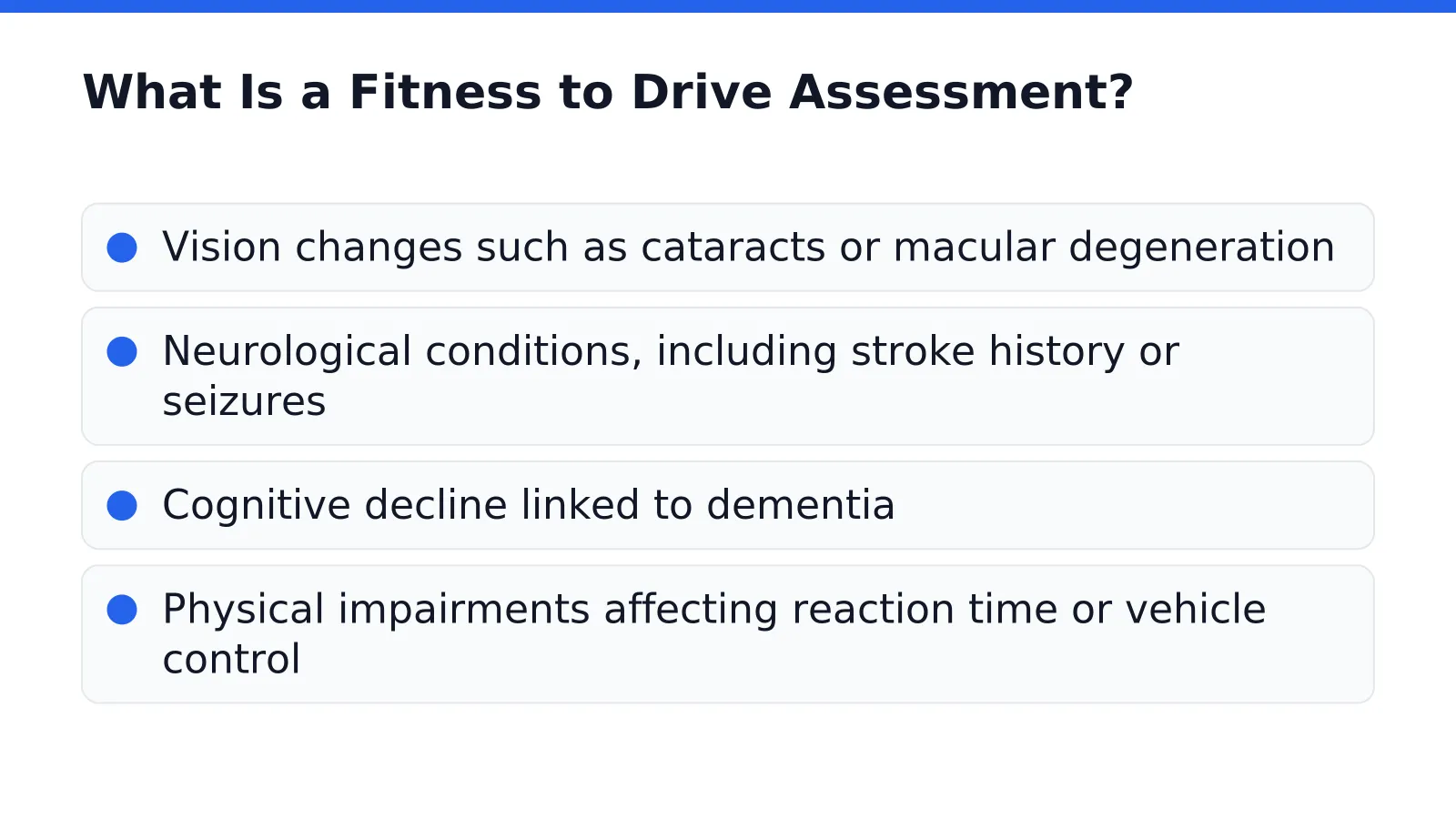
Health conditions affecting vision, mobility, or cognition commonly prompt a referral for review. Conditions evaluated often include:
- Vision changes such as cataracts or macular degeneration
- Neurological conditions, including stroke history or seizures
- Cognitive decline linked to dementia
- Physical impairments affecting reaction time or vehicle control
Does a medical condition automatically end someone’s driving?
No, a diagnosis alone does not end a license. The standards exist specifically to guide management of drivers with health conditions, allowing them to keep driving for as long as doing so remains safe. The goal is ongoing, evidence-based review rather than an automatic cutoff, balancing personal mobility against road safety for everyone sharing Victoria’s roads.

How Does the VicRoads Medical Review Process Work?
A general practitioner or specialist reviews a patient’s health condition and determines whether it affects safe driving ability. This evaluation forms the foundation of the vicroads medical review process used across Victoria. The clinician then documents findings and provides advice that supports a licensing decision, rather than making that decision directly.
Medical findings do not operate in isolation. These assessments, along with the national standards themselves, inform the decisions made by driver licensing authorities regarding who may hold a license. In Victoria, that authority reviews the clinical recommendation alongside other evidence before confirming, restricting, or suspending driving privileges.
The standards apply uniformly, not just in Victoria but across every Australian state and territory. They cover licensing decisions for private and commercial drivers operating heavy vehicles, light vehicles, and motorcycles alike. This national consistency means a medical driving assessment melbourne patients complete follows the same clinical framework used throughout the country.
What Does a Health Professional Actually Assess?
A health professional determines whether a diagnosed condition is likely to compromise safe driving, then advises accordingly. This is not a pass-or-fail test administered by the clinician. Instead, the doctor documents functional capacity, vision, cognition, and physical ability, then passes that information forward for licensing review.
How Do Doctors Use the Fitness to Drive Standards?
Clinicians rely on the standards to assess. Manage patients whose conditions may affect safe driving, including those completing a fitness to drive form victoria requires for license renewal or medical flagging. The process typically includes:
- Reviewing the patient’s diagnosis and current treatment
- Evaluating vision, motor function, and cognitive status against the national criteria
- Preparing recommendations for the licensing authority, not a final verdict
This structured approach gives families and carers a clear, evidence-based pathway when a loved one’s driving safety comes into question, whether through a vicroads fitness to drive assessment or an older driver safety review victoria clinicians initiate directly.
Who Needs an Age-Based Medical Review in Victoria?
Age alone does not trigger a mandatory medical review in Victoria. Laws governing older driver assessments differ across Australian states and territories, a complexity that makes evaluating an older patient’s fitness to drive a genuinely difficult task for families, carers, and healthcare practitioners alike.
Many assume a birthday alone sets off an automatic review. Research tells a different story. While aging affects driving-related skills such as reaction time. Visual processing, biological age alone remains an unreliable predictor of road fatalities. A healthy 80-year-old may retain sharper judgment behind the wheel than a 60-year-old managing several chronic conditions.
Does getting older automatically mean losing a driver’s license in Victoria?
No single age forces license loss. Many older drivers compensate for gradual slowing by building a mental map of potential hazards on familiar roads, a skill that offsets some physical decline. This mental mapping, sharpened over decades behind the wheel, often lets older Victorians drive safely well into later life, provided health changes are monitored closely.
Several circumstances commonly prompt a closer look at an older Victorian’s driving fitness:
- Vision changes, since an aging population is expected to see rising rates of vision-related driving impairment
- New or worsening health conditions affecting coordination, reaction time, or judgment
- Family or carer concern following a near-miss or driving incident
- A GP visit that uncovers a condition relevant to safe driving
Who typically starts the review process?
A GP visit often opens the door to a broader vicroads fitness to drive assessment, particularly when new health conditions surface during a routine checkup. Family members and carers also play a central role, raising concerns when they notice changes in confidence, awareness, or response time on the road. This combination, medical input alongside family observation, supports the kind of older driver safety review victoria families rely on to balance safety with continued independence.
What Do Vision and Cognitive Standards Require?
Driving demands complex visuospatial, cognitive, and physical abilities working together. Vision stands as the single most measurable determinant of road safety. A vicroads fitness to drive assessment examines each of these domains, not vision alone. Impaired coordination or slowed decision-making can be just as dangerous as reduced eyesight. Families supporting a mature driver through this process should understand that the standards exist to protect both the driver and everyone else on Victoria’s roads.
Several medical conditions carry particular weight in a medical driving assessment melbourne clinicians conduct. Progressive eye diseases, diabetes, and neurological conditions can all impair visual acuity and visual fields. That impairment raises the risk of a motor vehicle accident, which is why ongoing monitoring matters more as conditions progress rather than at a single point in time.
Does Victoria Have Its Own Vision Rules Beyond the National Standards?
Yes. Victoria has developed a distinct policy on bioptic telescopes, a type of vision aid some drivers use to magnify their field of view. This policy sits outside the national Assessing Fitness to Drive guidelines published in 2022, making it a state-specific addition rather than a replacement.
Under this Victorian policy, no driver may hold a license while using a bioptic telescope. The restriction applies broadly:
- Drivers assessed against private AFTD standards
- Drivers assessed against commercial AFTD standards
- Drivers who already meet the 2022 vision standards for licensing
- Drivers who do not meet those standards
This uniform application means medical history or license category does not create an exception. Any fitness to drive form victoria requires for an assessment should reflect this restriction clearly, giving GPs and specialists a consistent basis for their recommendations to licensing authorities.
How Can Families Support an Older Driver Safety Review?
Families play a direct role by organizing documentation, attending appointments, and reinforcing practice behind the wheel. Driving demands far more than muscle memory. It requires the simultaneous integration of sensory, motor, and cognitive abilities while responding to a constantly changing road environment. When adult children or carers understand this complexity, they can better support a relative through an older driver safety review victoria authorities recognize as standard practice.
Preparation starts with paperwork. Families should help gather medical history, prior assessment results, and any paperwork tied to the fitness to drive form victoria requires for licensing decisions. Clear records speed up the vicroads medical review process and reduce repeat visits to a general practitioner.
What Role Does Experience Play in an Older Driver’s Safety?
Experience offsets some age-related decline. Research from the University of Queensland indicates driving is a skill sharpened through years of practice, which helps many older drivers compensate for slower reflexes or reduced vision. This finding matters for families weighing whether a relative needs retraining versus retesting.
Should Families Seek Additional Driving Support Before a Review?
Yes, structured lessons often help. Refresher sessions covering road craft, defensive driving techniques, and current Victoria road rules give mature drivers a chance to rebuild confidence ahead of a vicroads fitness to [drive assessment](https://localdrivingacademy.com.au/areas/driving-school-hallam). Families considering a medical driving assessment melbourne clinician has flagged can pair that referral with practical coaching.
Families supporting an older driver should also know when concerns justify formal action:
- Document specific incidents, such as missed signals or confusion at intersections.
- Share observations directly with the treating GP before any review appointment.
- Understand the process to report unfit driver vicroads oversight requires if safety risks appear urgent.
A driving school operating in Victoria for more than a decade, having helped over ten thousand drivers obtain licenses, offers one option for families seeking structured, experience-based support. Your Local Driving Academy reflects the kind of long-standing local resource families can draw on during this process.
How Do You Report an Unfit Driver to VicRoads?
Families and carers in Victoria who notice a driver struggling with memory, vision, or reaction time can initiate a report unfit driver vicroads process through a general practitioner or specialist. Reporting begins with a medical conversation, not a phone call to authorities directly. Concealing concerns about a loved one’s driving carries real risk: unaddressed fitness issues put the driver, passengers, and other road users in danger. Driver health remains a core pillar of road safety across Australia. The physical and cognitive demands of operating a vehicle require sound vision, judgment, and reflexes.
A vicroads fitness to drive assessment typically starts when a GP, optometrist, or other health professional evaluates whether a medical condition is likely to interfere with safe driving. That professional’s role extends beyond diagnosis; the professional weighs the condition against driving demands and provides formal advice. This advice can become the basis for a report submitted on behalf of the patient.
What Role Does the GP Play in a Fitness to Drive Report?
General practitioners apply national medical standards to complete a medical driving assessment melbourne families frequently rely on when raising concerns about a parent or relative. Recommendations go directly to driver licensing authorities, supporting consistent, evidence-based decisions rather than informal judgment calls.
Typical pathways into Victoria’s vicroads medical review process include:
- A GP-initiated referral following a routine check-up or new diagnosis
- A specialist report tied to vision, neurological, or cardiac conditions
- A family-prompted conversation that leads to a formal fitness to drive form victoria submission
- An older driver safety review victoria triggered by age-related licensing requirements
Each pathway channels through a health professional rather than a direct public complaint line, keeping assessment grounded in clinical evidence rather than opinion.
Where to Get a Medical Driving Assessment in Melbourne?
General practitioners and accredited medical specialists across Victoria serve as the first point of contact for a medical driving assessment melbourne families typically pursue after a health scare or diagnosis. Occupational therapists provide the second layer, conducting structured off-road and on-road evaluations when a referring doctor flags a condition that might affect safe driving.
Several pathways exist depending on the health concern and the referral source. Common providers include:
- General practitioners completing initial health checks and fitness to drive form victoria paperwork
- Occupational therapy driving assessment services offering combined cognitive and practical road tests
- Specialist physicians (neurologists, ophthalmologists, cardiologists) addressing condition-specific risks
- VicRoads-registered assessors handling formal reviews tied to licensing decisions
What Happens During a VicRoads Medical Review?
A vicroads medical review process begins once a doctor, specialist, or concerned party submits medical information to the licensing authority. VicRoads then evaluates the report against the national medical standards and may request an on-road assessment before confirming, restricting, or suspending a license. This structured vicroads fitness to drive assessment protects both the driver and other road users while aiming to keep safe drivers on the road as long as possible.
Who Can Request an Older Driver Safety Review?
Family members, carers, and treating doctors can all initiate an older driver safety review victoria authorities recognize. Concerned parties may also choose to report unfit driver vicroads directly when safety risks appear urgent.
Learners completing medical clearance sometimes need refresher driving practice before returning to independent travel. Your Local Driving Academy, based in Hallam, Victoria, supports learners statewide with lessons in 5-star ANCAP-rated dual-control vehicles, guided by accredited male and female instructors, building on more than ten thousand drivers taught since 2006.
What Happens After Submitting the Fitness to Drive Form?
Submission of a fitness to drive form victoria triggers a structured review inside Victoria’s licensing system. Processing officers assess the medical information against national medical standards, cross-checking responses with established clinical criteria. These standards are not fixed documents. They undergo review approximately every three years, and a review of the 2022 edition has already begun. For families and carers supporting a mature driver, this ongoing revision matters because updated criteria can reshape future assessments down the line.
What Do the National Standards Actually Cover?
The framework behind a vicroads medical review process offers detailed guidance on how specific medical conditions may affect safe driving. This guidance draws on current medical evidence and input from medical associations and patient representative groups. A GP completing a medical driving assessment melbourne patients rely on references the same criteria, ensuring consistency no matter where the consultation takes place.
How Does Victoria Balance Safety and Mobility After Review?
An older driver safety review victoria families frequently ask about centers on balance, not restriction for its own sake. The standards exist to support nationally consistent, evidence-based decisions that weigh road safety against personal mobility. A favorable outcome may permit continued driving, sometimes with conditions attached. A less favorable one may prompt further assessment or a conditional license review.
Submitting documentation is one step within a larger system. Alongside a vicroads fitness to drive assessment, there’s a separate, formal pathway to report unfit driver vicroads authorities when safety concerns emerge outside the standard review cycle. Together, these mechanisms protect vulnerable road users while preserving independence wherever medically appropriate.
FAQ
What does a fitness to drive assessment evaluate?
It evaluates whether a driver’s vision, physical ability, and cognitive capacity meet the standard required for safe driving, following the national Assessing Fitness to Drive standards applied consistently across Victoria.
Does a medical diagnosis automatically end a person’s driving license?
The standards guide ongoing, evidence-based management, allowing drivers to continue driving for as long as it remains safe.
Who conducts the VicRoads medical review process?
A general practitioner or specialist reviews the patient’s health condition, documents findings, and provides advice supporting a licensing decision, rather than making that decision directly.
Conclusion
In closing, understanding VicRoads fitness to drive requirements and age-based medical review processes empowers families to support safer, more confident drivers across all life stages. Proactive engagement with these regulatory frameworks, whether navigating initial assessments or managing ongoing compliance, establishes the foundation for responsible vehicle operation. By prioritizing structured driver education and maintaining awareness of evolving health and licensing standards, families ensure that their drivers remain equipped with both the knowledge and the medical clearance necessary to operate vehicles safely on Victorian roads.