
Melbourne drivers face wet roads, tram tracks, and sudden stops that demand structured skill-building, not guesswork. Your Local Driving Academy, serving Melbourne since 2006, teaches emergency braking, hazard response, and wet-weather control through one-to-one lessons in dual-control vehicles. P-platers, fleet drivers, and licensed motorists gain practical, evidence-based defensive techniques for safer, more confident driving.
Key Takeaways
- Our 3-hour defensive driving course costs $199 and teaches practical emergency braking techniques.
- Hands-on training in controlled environments builds confidence handling wet weather and tram tracks safely.
- Advanced car control skills prepare Melbourne drivers for unexpected hazards and emergency situations.
- Your Local Driving Academy in Hallam delivers affordable safety training without lengthy classroom lectures.
What Is a Defensive Driving Course in Melbourne?
A defensive driving course melbourne program teaches drivers to anticipate danger before it happens, rather than reacting once a hazard is already underway. The underlying principle is simple: proactive hazard awareness, not split-second reaction, prevents collisions. Crash avoidance depends on noticing risk early and acting before a situation escalates. Staying alert to road conditions and responding with deliberate caution is what keeps a minor hazard from becoming a serious incident.
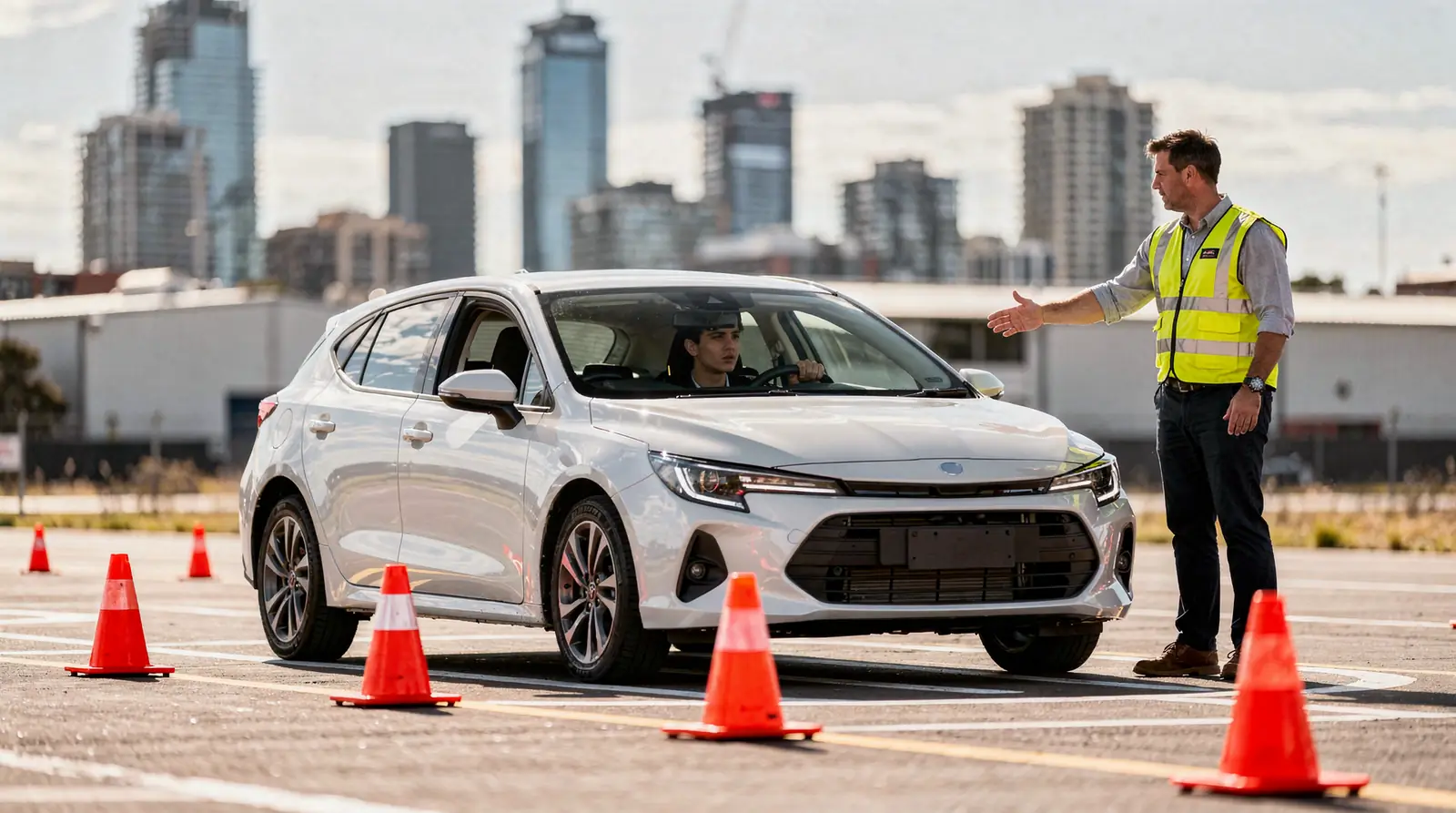
Melbourne training programs typically structure this education in three parts. Classroom discussion covers theory and hazard recognition. Safety instruction walks through specific scenarios, from merging traffic to sudden stops. In-seat coaching puts the driver behind the wheel of their own car, working alongside an instructor who demonstrates techniques and observes in real time.
Driving academies across Melbourne build these principles directly into structured lesson plans. Lessons combine advanced driver training melbourne concepts, broader road craft, and Victorian road rules within the same curriculum, often inside dual-control vehicles rated for safety performance. This integration means defensive skills develop alongside, not separately from, standard licensing preparation.
Who Should Take a Defensive Driving Course?
Licensed drivers, P-plate drivers moving to solo driving, and fleet drivers managing company vehicles all benefit from structured defensive instruction. Newly independent drivers face hazards without a supervising adult in the car for the first time. Fleet managers often require this training as a standard safety measure for corporate drivers operating company vehicles daily.
What Topics Does a Defensive Driving Course Cover?
Course content spans hazard perception, following distance, and vehicle positioning in traffic. Many programs also address wet weather driving tips melbourne motorists need, along with emergency braking techniques victoria drivers rely on in sudden-stop scenarios. Some curricula extend into skid control training melbourne instructors use to teach vehicle recovery after loss of traction.
Why Pursue Advanced Driver Training in Melbourne?
Advanced skills behind the wheel protect lives on Melbourne’s busiest arterials and congested freeways. Licensed drivers who complete advanced driver training Melbourne programs gain structured exposure to hazards that standard licensing rarely covers. Without that exposure, drivers default to reactive habits formed in low-stress conditions, habits that fail when traffic, weather, or mechanical surprise intervenes.
Core modules in these programs typically address three pillars: vehicle dynamics, adaptive driving, and advanced car control. Vehicle dynamics covers how weight transfer and traction affect handling under braking or cornering. Adaptive driving teaches drivers to adjust technique for changing road surfaces and visibility. Advanced car control builds precision in steering input. Recovery from unexpected slides, a skillset directly relevant to skid control training Melbourne motorists increasingly seek after wet-season incidents.
Program length varies by provider, but condensed formats have become common. Some courses run as short, focused sessions lasting only a few hours, designed to produce a safer, more confident driver without requiring a multi-day commitment. This intensive structure compresses essential skills into a tight timeframe rather than spreading instruction across weeks.
Is intensive training better than spreading lessons out over time?
Intensive formats suit drivers who want measurable progress fast. The concentrated block of practice builds muscle memory more efficiently than lessons separated by long gaps. Skills stay fresh between sessions rather than fading.
Who benefits most from a short, focused advanced course?
Drivers with limited availability, including P-platers balancing work and study, often prefer a single immersive block over an extended schedule. Fleet-based motorists facing tight rosters find the same compressed format practical. It delivers defensible skill gains without pulling staff off the road for multiple separate days.
How Does Wet Weather Affect Melbourne Driving?
Wet roads reduce tire grip, extend stopping distances, and raise the risk of losing vehicle control on Melbourne’s mix of arterial roads, tram tracks, and freeway stretches. Reduced traction changes how a car responds to braking, steering, and acceleration within seconds. Drivers who fail to adjust lose the margin for error that dry conditions normally allow.
Specific tools and technology exist to help motorists manage this reduced traction, from anti-lock braking systems to stability control. These systems assist, but they do not replace driver judgment. Understanding how a vehicle behaves when it starts to slip remains essential, which is why skid control training melbourne programs focus on recognizing and correcting loss of traction before it becomes a crash.
Why does hands-on practice matter more than theory in wet conditions?
Reading about hazards is not the same as reacting to one. Hands-on driving in a controlled environment teaches drivers how to respond when conditions shift without warning, such as a sudden downpour on a wet freeway. This practical exposure builds reflexes that classroom instruction alone cannot replicate.
Practicing hazard avoidance and emergency stopping in a driver’s own vehicle matters because it mirrors real conditions. Skills built this way, including emergency braking techniques victoria drivers can apply on slick roads, transfer directly to everyday commuting rather than staying confined to a training exercise.
Consistent application of defensive techniques in poor conditions carries measurable benefit. Defensive driving saves lives and reduces legal and financial exposure, a pattern that holds whether conditions are dry or wet. Melbourne’s unpredictable weather makes that consistency non-negotiable for:
- P-platers adjusting to solo driving without supervision
- Fleet drivers covering long daily distances
- Motorists seeking stronger wet weather driving tips melbourne conditions demand
Wet weather does not create new rules of physics. It simply removes the margin drivers rely on when conditions are favorable.
What Are Emergency Braking Techniques for Victorian Roads?
Emergency braking techniques describe the controlled stopping methods drivers use when a hazard appears with little warning, a factor that becomes critical on Melbourne’s congested arterial roads and wet, unpredictable laneways. Sudden stops demand precise timing and vehicle control, skills that separate a near-miss from a collision. Dedicated defensive driving course melbourne sessions treat emergency braking as a core, real-world competency, placing it alongside hazard recognition as a central part of structured instruction.
Formal sessions built around this skill often run as private, one-on-one instruction, structured entirely around the individual driver rather than a group curriculum. This format lets an instructor tailor pacing, repetition, and feedback to a driver’s current comfort level behind the wheel. For a P-plater transitioning to solo driving on Melbourne’s busier routes, that individualized attention builds muscle memory faster than shared classroom time ever could.
How is emergency stopping practiced safely?
Emergency stopping is rehearsed alongside hazard avoidance, typically using the driver’s own vehicle. The technique transfers directly to daily commuting. Practicing in a familiar car removes the guesswork of adjusting to unfamiliar pedal feel or braking distance under pressure. Instructors guide drivers through controlled repetitions, building confidence before real hazards appear on Melbourne roads.
Why do dual-control vehicles matter for braking practice?
Dual-control vehicles allow an instructor to intervene immediately if a braking maneuver goes wrong during practice. Modern automatic and manual cars fitted with these controls, carrying high ANCAP safety ratings, give learners room to push their limits without unnecessary risk.
Key elements of emergency braking instruction typically include:
- Reaction-time drills to shorten response delay before brake application
- Threshold braking practice to maximize stopping power without skidding
- Hazard-scanning exercises paired with sudden-stop scenarios
- Instructor-led feedback using dual-control safety backup
Together, these elements build a repeatable, transferable skill set suited to Melbourne’s mixed traffic conditions.
How Does Skid Control Training Work in Melbourne?
Skid control training builds a driver’s ability to recognize a loss of traction. Correct it before a minor slide becomes a collision. Vehicle dynamics instruction forms the technical foundation of this process, covering advanced driver training melbourne programs typically include adaptive driving and advanced car control principles. These concepts explain why a vehicle slides, how weight shifts during a skid, and what inputs restore grip.
Structured curricula build on that foundation rather than stopping at theory. Melbourne-based programs pair vehicle dynamics instruction with broader road craft, Victoria road rule review, and defensive driving course melbourne technique, often delivered inside modern dual-control automatic and manual vehicles. That dual-control setup matters because it lets a qualified instructor intervene instantly if a maneuver goes wrong, keeping the session safe while the driver practices.
What does in-car coaching for skid recovery actually look like?
In-seat coaching puts the instructor beside the driver in a real vehicle, not behind a desk. The instructor demonstrates correct steering and braking inputs during a simulated loss-of-traction event, then rides along as the driver repeats the exercise. This hands-on repetition trains muscle memory, so the correction becomes automatic rather than a panicked guess.
How does emergency braking practice connect to skid recovery?
Emergency stopping drills and hazard avoidance exercises build the same instinctive reflexes needed when a skid happens without warning. Practicing emergency braking techniques victoria instructors teach alongside skid control training melbourne sessions reinforces one skill set: controlled, decisive reaction under pressure. Core components typically include:
- Vehicle dynamics and adaptive driving theory
- Hazard recognition drills
- Emergency stopping practice
- Guided steering and braking correction during simulated slides
Each element reinforces the next, moving a driver from conceptual understanding to a response that holds up under real road conditions.
Why Do Melbourine Businesses Need Corporate Driver Training?
(typo check)
Why Do Melbourne Businesses Need Corporate Driver Training?
Fleet-operating companies face measurable financial exposure every time an employee gets behind the wheel. Crashes involving company vehicles generate repair costs, liability claims, and lost productivity that extend well beyond the incident itself. Corporate driver training Victoria programs address this exposure directly by building safer habits into everyday driving behavior across an organization.
Insurance costs offer one of the clearest business cases. Defensive driving habits carry a documented link to lower auto insurance premiums, a benefit that compounds across an entire fleet rather than a single vehicle. A business managing dozens of drivers multiplies that savings potential many times over.
Legal and financial risk reduction matters just as much. Safer driving behavior reduces the legal exposure that follows at-fault collisions, protecting both drivers and the organizations that employ them. For fleet managers, this translates into fewer claims, fewer workdays lost to injury, and reduced liability on the company’s record.
Does corporate driver training fit into a normal workday?
Yes. Condensed training formats lasting only a few hours fit into a standard workday without requiring a full day off-site. This structure suits professionals who cannot step away from operational duties for extended periods, making employer-sponsored instruction practical rather than disruptive.
What makes a Melbourne-based provider relevant for corporate fleets?
A Melbourne-area business benefits from training delivered by an organization already familiar with local road conditions and traffic patterns. Operating from a base in Hallam, Victoria, Your Local Driving Academy extends structured driver-training services to organizations throughout Melbourne.
Key business advantages of corporate driver training include:
- Lower auto insurance premiums tied to demonstrated defensive driving practices
- Reduced legal and financial liability from safer on-road behavior
- Shorter training sessions that minimize disruption to work schedules
- Consistent skill standards applied across an entire company fleet
These factors combine to make structured training a measurable investment rather than a discretionary expense.
How Do Tram Tracks Affect Defensive Driving in Melbourne?
Tram tracks create a fixed, unavoidable hazard that demands proactive positioning rather than last-second reaction. Steel rails run through a wide swath of Melbourne’s inner and middle suburbs, from St Kilda to Box Hill, and the grooves stay slippery long after rain has stopped. Awareness of this kind of hazard, paired with early lane choices, sits at the center of preventing collisions on tracked road surfaces. Motorists who drift close to parallel rails or cross them at a shallow angle risk a front wheel catching the groove, which pulls the car off its intended line.
Structured driver education addresses this directly. Lessons that combine road craft and defensive driving course melbourne instruction with time behind the wheel of dual-control vehicles give drivers practice on the exact surfaces they will face across the city’s tram network. A modern dual-control car, suited to varied road conditions, lets a learner feel how the vehicle responds without losing the safety net of an instructor’s backup controls.
Why does in-seat coaching matter for tram-track hazards?
In-seat coaching allows an instructor to flag a slick rail groove the moment it appears, rather than explaining it afterward in a classroom. That real-time correction builds the kind of advanced driver training melbourne drivers need before tackling tram corridors solo. Timing and angle, not speed alone, determine whether a crossing stays stable.
Emergency-stopping and hazard-avoidance drills reinforce this further. Practicing emergency braking techniques victoria-wide conditions require, including sudden traction changes over rails, helps a driver hold a straight line instead of overcorrecting. Key habits include:
- Crossing tracks at as close to a 90-degree angle as traffic allows
- Avoiding hard braking or sharp turns while wheels sit on rails
- Increasing following distance near tram stops and stacked traffic
Who Benefits Most From Defensive Driving Courses?
Busy professionals and time-pressed parents across Melbourne gain the most from short, several-hour course formats. These sessions fit neatly around work schedules and family commitments rather than demanding a full day away from other responsibilities. Practical skill-building happens efficiently, without sacrificing the depth needed to handle real hazards on Melbourne roads.
P-platers moving from supervised driving to solo trips also stand to gain significantly. A defensive driving course melbourne learners complete during this transition builds a mandatory grounding in vehicle control before higher-risk situations arise. Newer drivers without proven experience behind the wheel need this foundation before attempting more demanding conditions, such as night driving or highway merging.
Who should take advanced driver training in Melbourne?
Advanced driver training melbourne residents pursue typically includes motorists at any experience level seeking sharper control skills. Since 2006, structured instruction has helped more than ten thousand drivers across Victoria obtain their license, demonstrating applicability that spans beginners through experienced motorists refreshing their skills.
Does corporate fleet training offer different benefits?
Corporate driver training victoria fleet managers arrange serves a distinct purpose: reducing incident risk across a workforce rather than a single driver. A 12-person instructional team supports delivery of structured education throughout Melbourne, covering advanced and corporate-focused needs alongside standard lessons.
Several groups benefit most clearly:
- Professionals needing efficient, time-limited skill sessions
- P-platers transitioning out of supervised driving
- Mature or returning drivers rebuilding confidence
- Fleet operators responsible for workplace driving safety
Each group approaches the training with different goals, yet all rely on the same structured, evidence-based foundation.
FAQ
How much does the defensive driving course cost?
The course runs for 3 hours and costs pricing varies covering practical emergency braking techniques without lengthy classroom lectures.
Who benefits most from defensive driving training?
Licensed drivers, P-platers transitioning to solo driving, and fleet drivers managing company vehicles all gain practical, evidence-based defensive techniques through one-to-one lessons.
What skills does the course actually teach?
Lessons cover emergency braking, wet-weather control, hazard response, and vehicle positioning, delivered hands-on in dual-control vehicles at Your Local Driving Academy in Hallam.
Conclusion
In closing, mastering defensive driving techniques across Melbourne’s diverse road conditions, from wet weather hazards to tram track navigation and emergency braking scenarios, establishes the foundation for safe, confident driving throughout your motoring life. Structured, professional instruction in these critical competencies transforms theoretical knowledge into practical skill, equipping drivers to anticipate hazards, respond decisively, and protect themselves and others on every journey.