Successful VicRoads drive test preparation in Melbourne requires mastery of dashboard controls and awareness of common errors. Transport Victoria’s test evaluates real-world driving skills through varying traffic conditions. Your Local Driving Academy, established in 2006, has guided over ten thousand learners to licensure through structured, evidence-based instruction.
Key Takeaways
- The VicRoads drive test includes a pre-drive check and a two-stage on-road component.
- Failing the pre-drive vehicle check terminates the test immediately and forfeits the booking fee.
- Four critical errors cause most test failures: failing to give way, inadequate observation, speeding, and incomplete stops.
- Speeding in variable school zones triggers automatic failure because the testing officer records speed continuously.
What is the structure of the VicRoads drive test?
The VicRoads drive test comprises two distinct parts: a pre-drive check and an on-road driving component. The on-road component is further divided into two stages, and a learner must pass stage one before progressing to stage two.
Before the appointment, learners must complete and declare 120 supervised driving hours, if applicable, and pass the Hazard Perception Test. Transport Victoria’s drive test page confirms these prerequisites. Learners seeking Melbourne Driving Test Preparation Tips benefit from understanding this sequence before booking a test date.
What happens during the pre-drive check?
The pre-drive check occurs before the vehicle moves. The testing officer asks the learner to demonstrate operation of dashboard controls. These include indicators, hazard lights, windscreen wipers, and de-misters. Youth Central’s drive test guide highlights this requirement. Failing to locate a control quickly creates unnecessary pressure before the on-road segment begins.
How is the on-road driving component structured?
The on-road component follows a two-stage format. Stage one assesses basic vehicle control in lower-risk conditions. Passing stage one is mandatory to proceed to stage two. Stage two introduces more complex traffic situations. This staged design means a critical error in stage one ends the test immediately.
Learners preparing for the Hazard Perception Test should complete that assessment well before the drive test date. Your Local Driving Academy structures lessons around this exact test sequence, ensuring clients arrive with dashboard familiarity and stage-one competence already established.
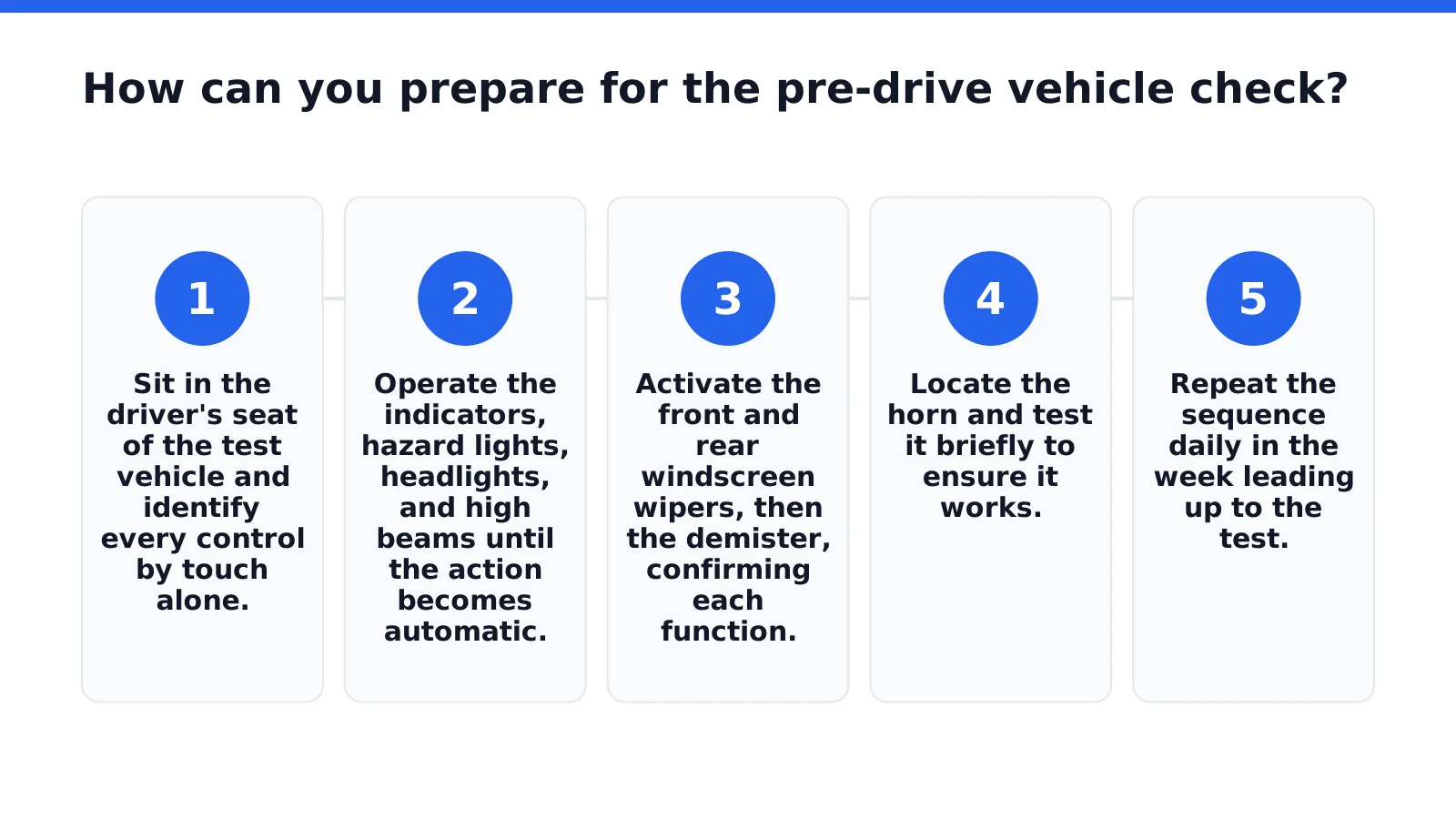
How can you prepare for the pre-drive vehicle check?
The pre-drive vehicle check is the first stage of the Melbourne drive test. A learner driver must demonstrate operational knowledge of dashboard controls before the on-road component begins. Failing this initial assessment terminates the test immediately, costing the applicant both the booking fee and the opportunity to progress.
Melbourne Driving Test Preparation Tips for this stage center on vehicle familiarity. Transport Victoria’s drive test guidelines confirm that the testing vehicle must meet all specified criteria. A vehicle fitted with an electronic or foot-operated park brake cannot be used for solo tests. This restriction eliminates many modern vehicles from eligibility and requires careful selection well before test day.
What dashboard controls does the examiner test during the pre-drive check?
The examiner asks the applicant to locate and operate specific controls. Indicators, hazard lights, windscreen wipers, and demisters are standard items. The Youth Central guide to the drive test emphasizes knowing the dashboard thoroughly. An applicant who hesitates or reaches for the wrong control signals unpreparedness.
How should a learner practice the pre-drive check before test day?
Practice follows a structured sequence. Follow these steps:
- Sit in the driver’s seat of the test vehicle and identify every control by touch alone.
- Operate the indicators, hazard lights, headlights, and high beams until the action becomes automatic.
- Activate the front and rear windscreen wipers, then the demister, confirming each function.
- Locate the horn and test it briefly to ensure it works.
- Repeat the sequence daily in the week leading up to the test.
The Youth Central guide advises putting time aside to learn exactly where each control sits and how it operates. This deliberate repetition builds the muscle memory that prevents test-day errors. A thorough understanding of VicRoads safety procedures reinforces the importance of these checks as a foundation for safe driving. Your Local Driving Academy structures pre-test lessons to include this dashboard drill, ensuring every learner enters the test with the vehicle knowledge the examiner requires.

What are the most common critical errors on the test?
Most VicRoads drive test failures stem from avoidable errors, not from lack of driving skill. Pressure distorts judgment, and a single critical error ends the test immediately. Melbourne learner drivers lose their chance at a probationary license over mistakes that structured preparation prevents.
Four critical errors account for the majority of test failures across Melbourne testing routes.
- Failing to give way or incorrect gap selection at roundabouts and intersections. A learner who hesitates too long or enters too aggressively commits an immediate critical error.
- Inadequate observation during reverse manoeuvres. Head checks and mirror use must be deliberate and visible to the testing officer.
- Speeding or creeping over limits in variable school zones. Melbourne school zones change limits at specific times, and exceeding the posted limit by even a small margin triggers automatic failure.
- Incomplete stops at stop signs. Rolling through a stop sign, even at low speed, counts as a critical error.
Which error causes the most immediate failures?
Speeding in variable school zones causes the most immediate failures. The testing officer records the speed continuously, and any breach ends the test on the spot. Melbourne learners must know school zone times and watch for electronic signage.
How do observation errors fail a test?
Observation errors fail a test because the testing officer cannot verify the learner’s awareness. A reverse manoeuvre without a full head check signals unsafe habits. The officer records inadequate observation as a critical error, not a minor fault.
Your Local Driving Academy addresses these errors through structured Melbourne Driving Test Preparation Tips that build correct habits before test day. A detailed breakdown of common driving test mistakes helps learners identify and correct these patterns early.
How do you navigate Melbourne-specific road conditions?
Navigating Melbourne roads demands mastery of conditions absent from most Australian driving tests. The VicRoads drive test evaluates skills through a short drive in varying traffic conditions, testing real-world competence rather than closed-course maneuvers. Learners who fail to prepare for Melbourne’s unique infrastructure risk test failure and the additional cost and delay of rebooking.
What are the most common Melbourne road rules that cause test failures?
Melbourne-specific road rules involving trams, hook turns, and cycling lanes require dedicated practice before test day. A learner who hesitates at a hook turn or passes a stopped tram incorrectly commits a critical error. These rules appear frequently on test routes near the CBD and inner suburbs.
Melbourne Driving Test Preparation Tips begin with structured exposure to these conditions. Practice sessions should target the following elements in sequence:
- Tram corridors with active boarding and alighting
- Marked hook-turn intersections during moderate traffic
- Roads with separated cycling lanes and bicycle awareness zones
How should learners practice for different intersection types?
VicRoads testing officers assess decision-making across multiple intersection configurations. Practice drives must cover traffic lights, give-way signs, and stop signs under varying traffic levels. This variety develops the prompt and confident responses the test demands.
Familiarity with the chosen VicRoads testing center routes improves performance by reducing uncertainty about road layouts and common hazards. Route knowledge allows the learner to anticipate rather than react. The company’s instructors provide targeted guidance on navigating Melbourne tram road rules, including the correct procedure for passing stopped trams and executing hook turns at marked intersections.
Consistent exposure to real traffic density builds the judgment required for stage two of the on-road test. Learners who train exclusively in quiet residential streets encounter conditions on test day that overwhelm their limited experience.
What final steps ensure test day readiness?
Final test day readiness requires a structured pre-test routine combining vehicle checks, documentation review, and a professional warm-up session. Learners who skip these steps risk preventable errors that cause immediate test failure.
What should a pre-test checklist include?
A complete pre-test checklist covers three categories. Logbooks must show the required 120 supervised hours fully declared. Documentation includes the learner permit and any applicable identification. Vehicle requirements demand functioning indicators, brake lights, headlights, and a clean windshield free of obstructions.
How does a warm-up lesson improve test performance?
A warm-up lesson with an accredited instructor on test day calms nerves and reinforces critical skills. The session allows learners to practice maneuvers, review common test routes, and receive immediate corrective feedback before the assessment begins. This focused preparation reduces the cognitive load during the actual test.
Your Local Driving Academy structures its drive test packages to include instructor vehicle use, pre-test warm-ups, and pick-up and drop-off options. The academy’s consistent, structured methodology produces strong outcomes for learners who complete systematic preparation. Learners who complete a driving test warm-up lesson enter the assessment with sharper hazard awareness and greater vehicle control.
Melbourne Driving Test Preparation Tips from experienced instructors emphasize arriving early, conducting a thorough pre-drive check, and using the warm-up to address last-minute uncertainties. Candidates who neglect these final steps often fail on basic control errors rather than complex traffic situations.
FAQ
How is the on-road driving component structured?
The on-road component has two stages. Stage one assesses basic vehicle control in lower-risk conditions, and passing stage one is mandatory to proceed to stage two.
Conclusion
Systematic preparation that targets the specific failure points outlined above (observation, speed compliance, intersection judgment, and Melbourne-specific road rules) directly determines test outcome. Learners who address these areas through structured practice and a pre-test warm-up session enter the assessment with the skills and composure required to pass. The next step is to book a professional evaluation of your current driving against these test standards.