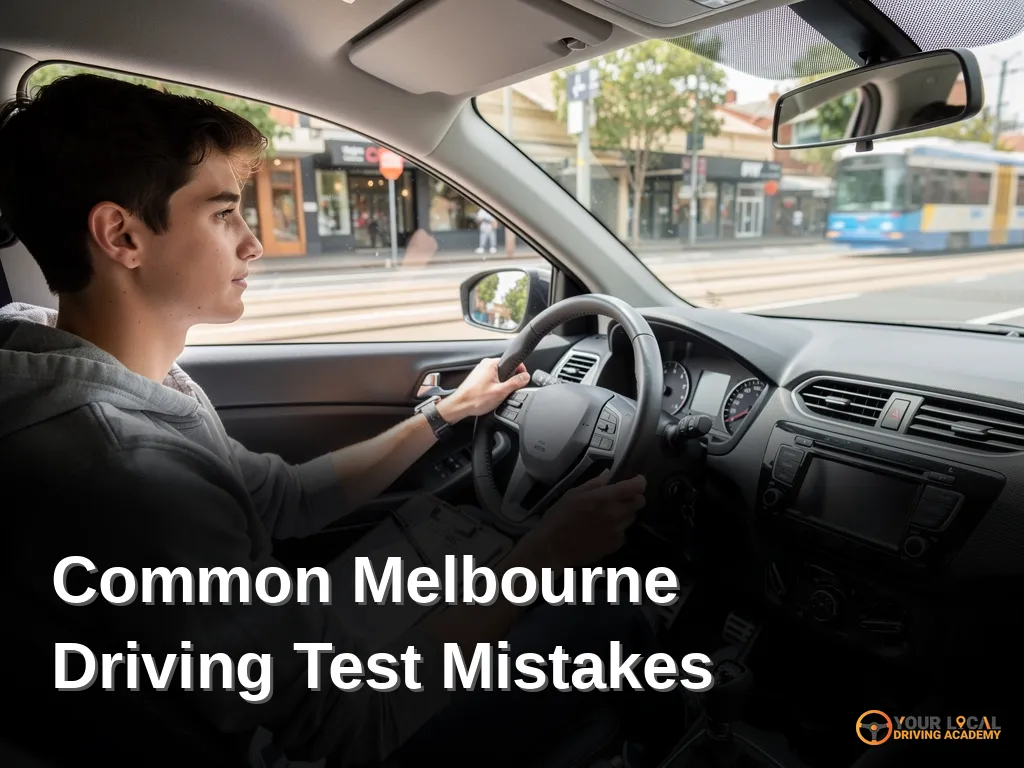
Common driving test mistakes in Melbourne (including failed observation at intersections, incorrect speed management, and poor gap selection) are avoidable with structured coaching. Your Local Driving Academy builds hazard awareness and confidence through How to Pass Your VicRoads Driving Test First Time: Practical Tips, Routes & Comm on VicRoads test routes before assessment day.
Key Takeaways
- Mirror checks every 5 to 8 seconds in normal driving are required by VicRoads examiners.
- Incorrect positioning at intersections remains a consistent problem for learners navigating Melbourne’s road network.
- Observation failures, positioning errors, and pressure-induced mistakes cause the most frequent test failures.
- A pre-test warm-up session allows the learner to acclimate to the vehicle and testing area before the examiner arrives.
What are the most common Melbourne driving test mistakes?
Insufficient mirror checks cause more Melbourne driving test failures than almost any other error. VicRoads examiners specifically watch for regular, deliberate mirror checks throughout the assessment. Learners who neglect this fundamental habit lose marks rapidly, often failing before the test reaches its halfway point.
Melbourne driving test mistakes extend well beyond mirror discipline. Incorrect positioning at intersections remains a consistent problem for learners navigating the city’s demanding road network. Melbourne presents one of Australia’s most complex driving environments. Hook turns, tram tracks, clearway restrictions, speed limit changes, and roundabouts combine to create conditions that overwhelm underprepared candidates.
Why do mirror checks matter so much during a Melbourne driving test?
VicRoads examiners apply a strict standard for mirror checks. The requirement is a mirror check every 5 to 8 seconds in normal driving. Additional checks must occur before every brake application, lane change, and turn. Missing these deliberate observations signals poor situational awareness. Examiners interpret infrequent mirror use as a critical safety deficiency rather than a minor oversight.
How does Melbourne’s road environment contribute to test failures?
The city’s infrastructure demands constant positional precision. Tram tracks require specific lane discipline. Hook turns force unfamiliar manoeuvres at major intersections. Clearway restrictions change lane availability by time of day. Speed limit changes occur frequently across suburban and inner-city routes. Roundabouts test gap selection and signalling under pressure. Learners who practise only in quiet residential streets encounter these challenges for the first time during their assessment. The result is hesitation, incorrect lane choice, and critical errors that end the test.
Driving assessment tips Victoria instructors emphasise focus on deliberate observation routines. Learner driver test errors Melbourne examiners report most frequently stem from habits that proper supervised practice corrects well before test day.

How can you prepare for the VicRoads drive test?
Effective preparation for the VicRoads drive test requires Melbourne Driving Test Preparation Tips. Melbourne driving test mistakes often stem from gaps in formal training rather than a lack of basic ability. Your Local Driving Academy delivers a systematic learning framework that builds competence through progressive skill development. The academy’s accredited instructors guide learners from foundational control through to complex traffic navigation.
A systematic approach to preparation demonstrates the effectiveness of this methodology. Learners who attempt the test without professional preparation risk failing on technical observations they never knew existed. The cost is not just the re-test fee. It is weeks of waiting for another booking slot and the erosion of confidence that follows an unexpected failure.
What does a drive test preparation package include?
Drive test packages provide comprehensive support on assessment day. The package includes use of the instructor’s vehicle, a pre-test warm-up session, and pick-up and drop-off options. This removes logistical stress and allows the learner to focus entirely on performance.
The warm-up session is particularly valuable. It gives the learner time to acclimate to the vehicle and the testing area before the examiner enters the car. Familiarity with the controls and local road conditions reduces anxiety and sharpens observation habits.
Why does the training vehicle matter for test success?
The vehicle used during lessons and the test directly influences performance. Your Local Driving Academy conducts all training in modern dual-control cars with high safety ratings. Dual controls provide an essential safety net during lessons. They also signal to the examiner that the learner trained in a professional environment.
Examiners observe comfort and fluency behind the wheel. A learner who has practised exclusively in a well-maintained, contemporary vehicle develops smoother control inputs. This fluency translates into the confident, deliberate actions that VicRoads assessors expect. Driving assessment tips Victoria from experienced instructors consistently emphasise vehicle familiarity as a foundational element of test readiness.

What specific errors should learner drivers avoid?
Learner drivers in Melbourne face a defined set of Melbourne driving test mistakes that consistently cause test failure. A former VicRoads Licence Testing Officer who conducted over 1,800 official drive tests observed the same errors appearing repeatedly across nervous and confident candidates alike. These learner driver test errors Melbourne examiners flag most often are entirely preventable with VicRoads Driving Test Preparation Tips for Melbourne Learners.
The most frequent errors fall into three categories: observation failures, positioning errors, and pressure-induced mistakes. Each category represents a critical assessment point where VicRoads examiners deduct marks or issue immediate fail outcomes.
What observation errors do Melbourne driving examiners penalise most?
Observation failures dominate driving assessment tips Victoria instructors emphasise during test preparation. Mirror checks must occur every 5 to 8 seconds during normal driving, plus before every brake application, lane change, and turn. Examiners specifically watch for deliberate head movement. A candidate who glances without moving their head risks failing the observation component entirely.
Incorrect intersection positioning forms the second major error cluster. Learners frequently misjudge lane selection on multi-lane Melbourne roads or position their vehicle incorrectly when turning at traffic lights. The former testing officer noted that positioning mistakes often stem from hesitation rather than skill deficits. Candidates who second-guess their lane choice mid-intersection create dangerous situations that trigger automatic test termination.
How do pressure-induced errors affect Melbourne driving test results?
Pressure amplifies minor technical faults into critical errors. Candidates who drive competently during lessons sometimes perform basic manoeuvres incorrectly under test conditions. Rolling stops at stop signs, failing to indicate when leaving roundabouts, and incomplete head checks before lane changes all increase under assessment pressure. The VicRoads examiner’s data confirms that these errors appear regardless of a candidate’s pre-test confidence level.
Systematic preparation reduces these errors. Structured practice on actual test routes builds familiarity with high-risk intersections. Deliberate mirror-checking routines developed during lessons become automatic under pressure. Candidates who treat every practice drive as a mock assessment develop the consistency VicRoads examiners require for a first-attempt pass.
How does Melbourne’s road layout affect test performance?
Melbourne’s road network presents specific challenges that directly influence driving test outcomes. Hook turns, tram tracks, clearway restrictions, speed limit changes, and roundabouts create a demanding environment for learner drivers. Monika’s Driving School identifies these elements as core factors in Melbourne driving test mistakes, noting that even experienced drivers make errors on Melbourne roads.
The complexity extends beyond static infrastructure. Melbourne’s unpredictable weather conditions add another layer of difficulty for new drivers. Rain, glare, and sudden visibility changes force rapid adjustments during assessment conditions.
What makes Melbourne roads harder than other Australian cities?
Melbourne combines tram infrastructure with standard traffic flow. Learners must process tram signals, track positioning, and hook turn protocols simultaneously. This cognitive load increases error rates during tests.
How should learners prepare for Melbourne-specific road features?
Driving assessment tips Victoria emphasise structured preparation:
- Practise hook turns in low-traffic periods before attempting them under test pressure.
- Drive tram-corridor routes repeatedly to build familiarity with track positioning.
- Study clearway signage and time restrictions on common test routes.
- Complete practice sessions in wet weather to build confidence in reduced visibility.
Learner driver test errors Melbourne frequently stem from unfamiliarity rather than skill deficits. Targeted practice on complex intersections reduces this risk.
What coaching strategies improve driving assessment outcomes?
Effective coaching strategies reduce Melbourne driving test mistakes through structured, evidence-based instruction. A formal, step-by-step learning framework delivers measurable improvements in assessment performance. Learners who follow systematic progression master foundational skills before advancing to complex traffic scenarios.
Driving assessment tips Victoria instructors emphasise centre on three core coaching methods. First, accredited instructors provide patient, professional guidance tailored to each learner’s specific needs. Second, practical test-route familiarity combined with real-world hazard awareness builds both skill and confidence efficiently. Third, consistent mirror-checking rituals eliminate one of the most common assessment errors.
How does structured lesson progression improve test readiness?
A formal learning framework prevents skill gaps that surface during assessments. Each lesson builds on the previous one. Learners master basic vehicle control before tackling Melbourne’s challenging intersections and variable speed zones. This sequential approach ensures no critical competency remains undeveloped when test day arrives.
Why does test-route practice matter for Melbourne assessments?
Familiarity with actual VicRoads test routes reduces cognitive load during the assessment. Learners who practise on these roads recognise intersection layouts, speed limit changes, and common hazard points. Real-world hazard awareness training transfers directly to safer decision-making under examination conditions.
What role does instructor feedback play in correcting errors?
Accredited instructors identify subtle errors before they become ingrained habits. Tailored feedback addresses each learner’s specific weaknesses rather than applying generic corrections. Mirror checking serves as a prime example: instructors coach learners to make deliberate checks a conscious ritual until the behaviour becomes automatic. This targeted intervention prevents the observation failures that frequently cause assessment deductions.
FAQ
What are the most common mistakes that cause Melbourne driving test failures?
Insufficient mirror checks, incorrect positioning at intersections, and poor gap selection cause the most frequent test failures.
How often must you check your mirrors during a VicRoads driving test?
VicRoads examiners require a mirror check every 5 to 8 seconds in normal driving, plus additional checks before every brake application, lane change, and turn.
How does Melbourne’s road environment create challenges for learner drivers?
Hook turns, tram tracks, clearway restrictions, speed limit changes, and roundabouts combine to overwhelm underprepared candidates, causing hesitation and critical errors.
Conclusion
Structured preparation on Melbourne’s specific road features, combined with deliberate mirror-checking rituals and test-route familiarity, directly reduces the cognitive load that causes assessment errors. Learners who adopt a formal, step-by-step framework and treat every practice drive as a mock assessment build the consistency required for a first-attempt pass. The next step is to book a lesson focused on high-risk intersections and hook turns.