
NDIS-supported driving lessons in Melbourne pair occupational therapy assessments with structured, one-to-one instruction for participants building safe, independent driving skills. Your Local Driving Academy delivers accredited instruction in dual-control vehicles following OT recommendations, supporting first-time learners, license retention, and license regaining through consistent, evidence-based progression toward test readiness.
Key Takeaways for NDIS Driving Lessons and OT Assessments
- OT driving assessments support NDIS participants to drive safely, independently, and legally in Melbourne.
- Your Local Driving Academy in Hallam serves learner drivers through structured assessment processes tailored to individual needs.
- Occupational Therapy assessments help drivers maintain licenses after illness, injury, or extended driving breaks.
- Professional driving evaluations address safety factors influencing your ability to drive independently and confidently.
What Will This NDIS Driving Guide Help You Achieve?
This guide equips NDIS participants, support coordinators, families, and occupational therapists across Melbourne with a clear roadmap for building safe, independent driving skills. Losing access to a driver’s license, or struggling to obtain one, removes more than convenience. Driving functions as a pillar of independence, community connection, and personal freedom for countless individuals. Any barrier to it carries real cost to daily life and self-determination.
The guide breaks the process into a practical sequence. Before starting, participants should confirm eligibility and gather any medical or NDIS documentation relevant to their driving goals.
- Identify whether a formal Occupational Therapy driving assessment is required, based on medical history, disability, or licensing stage.
- Book an OT Driving Assessment Melbourne provider experienced with off-road and on-road evaluation methods.
- Discuss funding pathways, including NDIS funding categories CB Daily Living Core, with a support coordinator.
- Arrange structured NDIS Driving Lessons with an instructor trained to work alongside OT recommendations.
- Trial any recommended vehicle assistive technology adaptations before committing to permanent modifications.
What makes an OT driving assessment different from a standard test?
An assessment conducted by a driver-trained Occupational Therapist goes far beyond a standard road test. It evaluates cognition, vision, and physical capacity, then links results to concrete driving recommendations, including whether spinner knobs hand controls left foot accelerators or other equipment would support safer control of the vehicle.
Why does structured support matter for learners with a disability?
Driving involves physical, visual, thinking, and regulatory skills operating simultaneously. Structured NDIS driving lessons Melbourne programs address each skill area methodically, reducing risk and building genuine confidence rather than assumed competence. Your Local Driving Academy has established a strong track record in driver education across Melbourne, which supports the credibility of this guide.

Who Needs An OT Driving Assessment In Melbourne?
Four distinct groups of Melbourne drivers benefit from an OT Driving Assessment Melbourne services provide: learners starting out, license holders managing a disability, experienced drivers flagged for review, and anyone recovering from illness or injury. Skipping this step carries real consequences. A learner without proper evaluation risks delayed licensing. An experienced driver ignoring a medical condition risks losing driving privileges altogether.
Learner drivers form the first group. Assessment supports first-time and learner drivers from the earliest stages, well before they get behind the wheel, through to the point of earning a full license. Structured evaluation at this stage builds safe habits early.
License holders managing a disability make up the second group. Drivers whose disability affects their driving ability use assessment to maintain their existing license rather than lose it. This applies whether the condition is stable or progressive.
Experienced drivers are not exempt. Even a driver with years behind the wheel may be asked to complete an Occupational Therapy driving assessment if concerns arise about safety.
Does age or illness affect driving ability?
Ageing, illness, and injury all change the physical, visual, thinking, and regulation skills driving demands. These changes are not always obvious to the driver, which is why formal assessment matters more than self-judgment.
What conditions might trigger an assessment?
Several medical circumstances commonly prompt a referral, including:
- Physical injury or head injury
- Illness or disability affecting coordination
- Stroke
- Psychiatric conditions
- Medication side effects impairing reaction time
Support coordinators, occupational therapists, and families across Melbourne rely on this framework to determine when structured evaluation, followed by supervised NDIS driving lessons Melbourne instructors deliver, gives a driver the clearest path back to safe, independent road use.
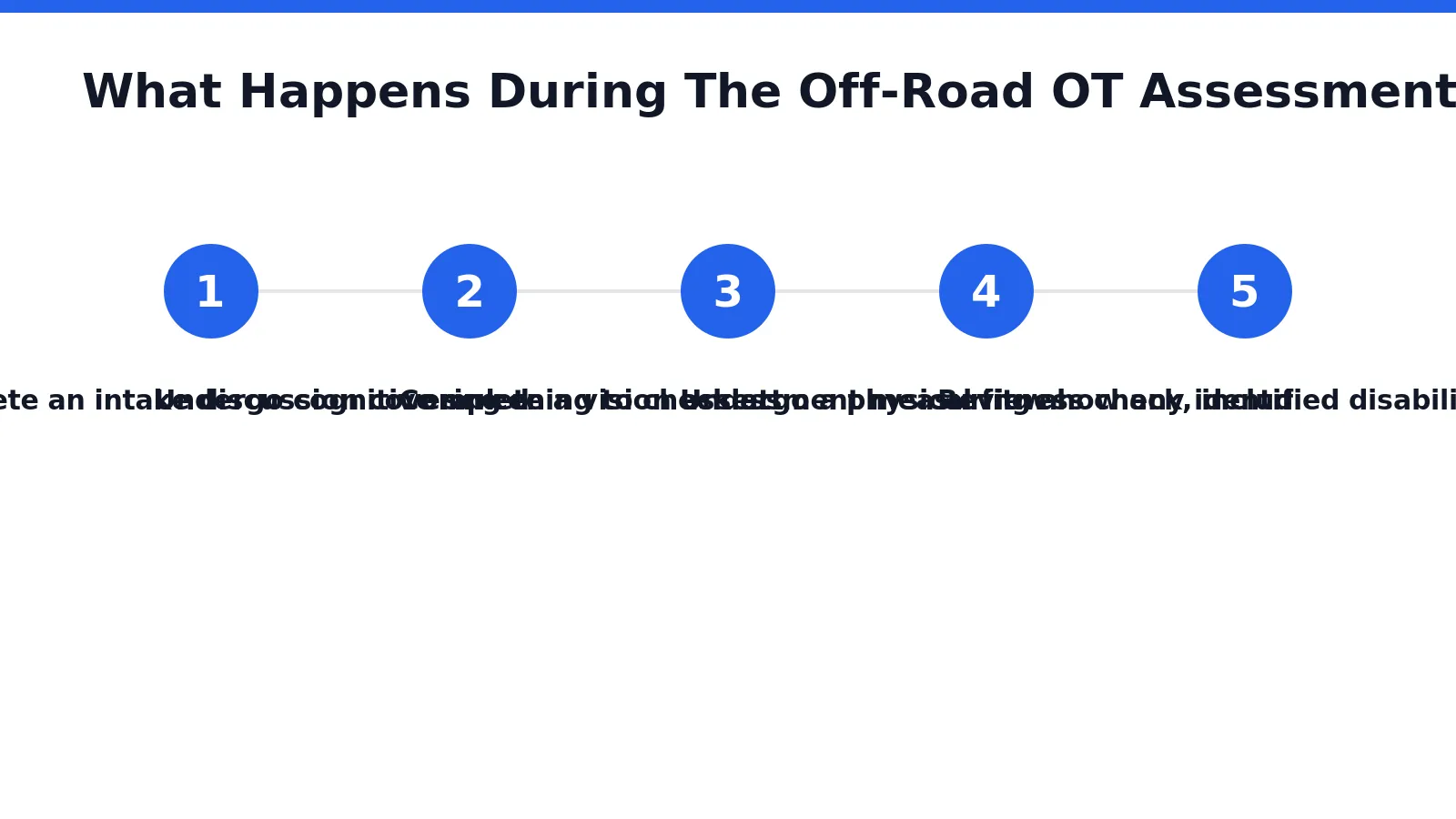
What Happens During The Off-Road OT Assessment?
Occupational Therapy driving assessment procedures begin indoors, away from traffic, before any vehicle is involved. A driver-trained occupational therapist evaluates cognitive function, vision, and physical fitness first, then measures how a disability affects driving performance. This structure exists because driving demands physical, visual, thinking, and regulation skills operating together — a loss in any single area changes the whole picture.
For participants and families across Melbourne arranging an OT Driving Assessment Melbourne appointment, understanding the off-road sequence removes much of the uncertainty around what to expect.
What Does the OT Ask About Before Testing Begins?
Before any formal testing, the occupational therapist asks about the participant’s driving history and current circumstances. This conversation establishes context: how long the person has held a license, what conditions or injuries are relevant, and what driving goals matter most. Nothing about the vehicle is assessed yet — the focus stays on the person.
How Does the Off-Road Component Proceed?
- Complete an intake discussion covering driving history and current medical or cognitive concerns.
- Undergo cognitive screening to check attention, memory, and decision-making speed.
- Complete a vision assessment measuring acuity and field of view.
- Undergo a physical fitness check, including strength, range of motion, and reaction time.
- Review how any identified disability specifically affects driving-related tasks.
Each step builds toward a single outcome: a clear, evidence-based picture of readiness before the on-road stage begins. Occupational Therapy driving assessments in South East Melbourne follow this same off-road framework regardless of the participant’s age or condition. Results from this stage directly shape what happens next. The on-road evaluation, where those cognitive, visual, and physical findings are tested against real driving conditions. Skipping straight to on-road testing without this groundwork would leave gaps in understanding a participant’s true capability behind the wheel.
What Happens During The On-Road Driving Assessment?
Driver-trained occupational therapists partner directly with an NDIS-funded driving instructor to evaluate practical skills and road knowledge on Melbourne streets. This on-road stage forms the second half of a five-step process that begins with an off-road evaluation. Ends with a comprehensive report submitted to VicRoads. Participants across South East Melbourne complete this stage in real traffic conditions, giving assessors an accurate picture of driving ability rather than a simulated one.
The sequence typically unfolds as follows:
- Complete the off-road evaluation of cognitive, visual, and physical function.
- Meet the NDIS-funded driving instructor for the scheduled on-road session.
- Demonstrate driving skills and road knowledge across varied Melbourne traffic environments.
- Receive feedback on any need for vehicle assistive technology adaptations, including spinner knobs hand controls left foot accelerators.
- Await the comprehensive report submitted to VicRoads following the session.
Should participants take a lesson before the assessment?
Anyone who has not driven for an extended period. Who feels uncertain behind the wheel, benefits from arranging a driving lesson beforehand. Preparation of this kind gives participants the best chance of demonstrating true ability rather than rustiness from time away from driving. NDIS driving lessons Melbourne providers can structure this kind of warm-up session ahead of the formal assessment date.
How can participants prepare for what the assessment involves?
Reviewing the VicRoads website before the appointment helps participants understand each stage of the process in greater detail. This step matters particularly for families and support coordinators unfamiliar with how an OT Driving Assessment Melbourne appointment is structured. Combining that research with a pre-assessment lesson, arranged through qualified NDIS Driving Lessons services, gives participants a clearer, calmer path into assessment day and reduces uncertainty about what the on-road evaluation will require.
How Does NDIS Funding Cover Driving Support?
NDIS funding categories CB Daily Living Core typically cover assessment and driving-support services for participants whose disability affects their ability to drive safely. Core Support funding under the National Disability Insurance Scheme exists to build everyday capacity, and driving falls squarely within that goal for many South East Melbourne participants. Losing funded access to this pathway often means losing independence, delayed licensing, and continued reliance on carers for transport.
Coordinating a claim starts before a single lesson takes place. Support coordinators and families in Melbourne generally follow this sequence:
- Confirm eligibility with the NDIS planner and identify whether driving support sits under Core or Capacity Building categories in the current plan.
- Book an OT Driving Assessment Melbourne service to establish a documented baseline of cognitive, physical, and visual driving capacity.
- Review OT recommendations, which often include driver rehabilitation, vehicle assistive technology adaptations, or updated license conditions.
- Arrange funded lessons with an instructor experienced in NDIS-supported tuition, coordinating logistics around the participant’s plan review dates.
An Occupational Therapy driving assessment anchors this process. A driver-trained occupational therapist evaluates whether a participant can continue driving safely, independently, and legally, then documents findings the NDIS uses to justify funded support. Recommendations frequently extend to equipment such as spinner knobs, hand controls, and left-foot accelerators, matched to the participant’s specific physical needs.
What does an OT assessment recommend after the review?
Driver-trained OTs commonly recommend a combination of rehabilitation training, vehicle modifications, and formal license conditions tailored to the individual. These recommendations give participants applying for a license, or returning to driving after injury or illness, a clear and structured path forward. The goal is consistent: build the skills and confidence needed to drive competently, comfortably, and safely.
For Melbourne families navigating this system, NDIS driving lessons Melbourne providers coordinate directly with OT recommendations, ensuring funded lessons align with documented assessment outcomes rather than generic instruction.
What Vehicle Modifications And Assistive Technology Help?
Vehicle assistive technology adaptations range from simple steering aids to full hand-control systems, matched to each driver’s physical and cognitive profile. Many individual factors influence a driver’s ability to operate a vehicle safely. No single modification suits every Melbourne learner or returning driver. An Occupational Therapy driving assessment identifies which adaptations address a specific limitation before any equipment gets fitted or lessons begin.
Medical conditions, injuries, and disabilities affect driving performance in different ways. Physical skills or thinking abilities, including memory and speed of thinking, sometimes change after a license has already been issued. These shifts do not automatically end a person’s driving career; adaptive equipment frequently restores safe, independent control.
Common adaptations recommended following an OT Driving Assessment Melbourne include:
- Spinner knobs, hand controls, left foot accelerators — for drivers with reduced leg strength, amputation, or coordination changes
- Modified mirrors and sensory aids — for drivers managing vision or spatial-awareness changes
- Pedal extensions or relocated pedals — for drivers with limited lower-limb mobility
- Steering wheel modifications — for drivers with restricted grip strength or range of motion
How does an OT decide which adaptations are needed?
Occupational therapists uniquely trained in driving evaluate physical, cognitive, and sensory function before recommending equipment. Assessment findings, not guesswork, determine whether a driver needs hand controls, a left foot accelerator, or a combination of aids. This structured evaluation protects against fitting unnecessary or mismatched technology.
Can modified vehicles be used during lessons?
Yes. Specialized instruction following illness, injury, or an extended break from driving typically incorporates the same adaptations identified in the assessment. Practicing in a correctly modified vehicle builds accurate muscle memory and confidence ahead of on-road testing. Your Local Driving Academy coordinates lesson delivery across Melbourne to align with each participant’s assessed equipment needs.
How Do You Book NDIS Driving Lessons?
Booking begins with a referral or direct inquiry to a driving school experienced in NDIS-supported instruction. NDIS driving lessons Melbourne participants can access follow a structured intake process, ensuring each learner’s support needs, funding category, and vehicle requirements are confirmed before the first lesson. Skipping this step often delays scheduling, so completing it early keeps the process on track.
Four steps typically guide the booking process:
- Confirm NDIS plan details and funding approval with a support coordinator or plan manager.
- Contact the driving school to discuss learner needs, including any required vehicle assistive technology adaptations.
- Schedule an initial lesson or, where recommended, an OT Driving Assessment Melbourne families rely on to identify appropriate equipment.
- Confirm instructor preference and lesson frequency based on logbook hour goals.
Your Local Driving Academy operates from Hallam, Victoria, and serves learners across the greater Melbourne metropolitan area. A team of 12 employees supports scheduling, instructor matching, and lesson logistics for learners throughout the region. The academy has delivered reasonably priced driving lessons to learners pursuing a Victorian license, giving South East Melbourne families a long track record to rely on.
Do NDIS participants need an OT assessment before booking lessons?
Not always, but many benefit from one. An Occupational Therapy driving assessment identifies physical, cognitive, and sensory factors affecting driving readiness. Where spinner knobs hand controls left foot accelerators or other modifications are indicated, the assessment guides which equipment a lesson vehicle must accommodate before training starts.
Can learners request a specific instructor?
Yes. Accredited male and female instructors are available, allowing learners to select based on comfort and communication preference. This flexibility matters for NDIS participants who benefit from consistency with a familiar instructor across sessions funded under NDIS funding categories including CB Daily Living Core supports.
What Mistakes Should You Avoid Before Testing?
Skipping a pre-assessment refresher lesson ranks among the most common errors Melbourne learners make before an OT Driving Assessment Melbourne. Clients who arrive without recent practice behind the wheel reduce their chance of driving safely and confidently on test day. Preparation matters as much as the assessment itself.
Self-awareness gaps present another risk. Many drivers remain unaware of changes in their own abilities, especially shifts in cognitive function, until an assessment reveals the issue. Family members, allied health professionals, and general practitioners often notice these changes first. Consulting a GP or allied health team before booking an assessment helps clarify how a medical condition or injury may affect readiness to start, resume, or continue driving.
Why does a medical condition affect eligibility for testing?
A medical condition or disability can determine whether a driver qualifies to obtain or retain a license. An assessment identifies whether current health status supports safe, independent driving.
What preparation steps reduce risk before assessment day?
- Schedule a refresher lesson with a qualified instructor beforehand.
- Discuss any recent health or cognitive changes with a GP or allied health professional.
- Gather input from family members who observe day-to-day driving behavior.
- Confirm assessment requirements match individual medical circumstances.
FAQ
What does an OT driving assessment evaluate?
An OT driving assessment evaluates cognition, vision, and physical capacity, then links results to concrete driving recommendations, including equipment like spinner knobs, hand controls, or left foot accelerators.
Who provides NDIS driving lessons in Melbourne?
Your Local Driving Academy, based in Hallam, Victoria, provides accredited NDIS driving instruction in dual-control vehicles, following OT recommendations for participants working toward safe, independent driving.
Who benefits from an OT driving assessment?
Four groups benefit: learners starting out, licence holders managing a disability, experienced drivers flagged for review, and anyone recovering from illness or injury.