By Eiad Chisty, Your Local Driving Academy
Navigating the driving test presents unique challenges for learner drivers, especially in areas such as Pakenham where specific testing routes reflect local traffic conditions. This comprehensive guide is designed to equip you with the knowledge needed to confidently approach the VicRoads Pakenham driving test. Learn about the test centre, route anatomy including Stage 1 and Stage 2 specifics, critical local hazards, common fail traps, and effective preparation strategies.
Whether you’re about to undertake your driving test or planning your preparation, understanding these elements will help boost your confidence and improve your chances of success.
Executive Summary & Introduction
The VicRoads Pakenham Customer Service Centre, located at Southeast Blvd, Pakenham VIC 3810, is the focal point for all learner driver assessments in this growing Melbourne suburb. Knowing this centre and the surrounding roads intimately is more than just convenience—it significantly increases first-time pass rates. Local route familiarity helps candidates anticipate and react effectively to the unique traffic conditions and hazards present in Pakenham, from complex multi-lane roundabouts to rapid speed transitions and heavily trafficked railway level crossings.
Incorporating thorough knowledge, precise maneuvers, and well-practiced skills tailored to these vicroads pakenham test routes can turn an intimidating assessment into a manageable and even confidence-building experience. The following sections provide detailed insights and practical pakenham driving test tips to help learner drivers prepare rigorously and succeed.
VicRoads Pakenham Drive Test Structure (Stage 1 vs Stage 2)
The VicRoads driving test in Pakenham is thoughtfully delineated into two stages, each designed to assess different driving capabilities relative to local conditions.
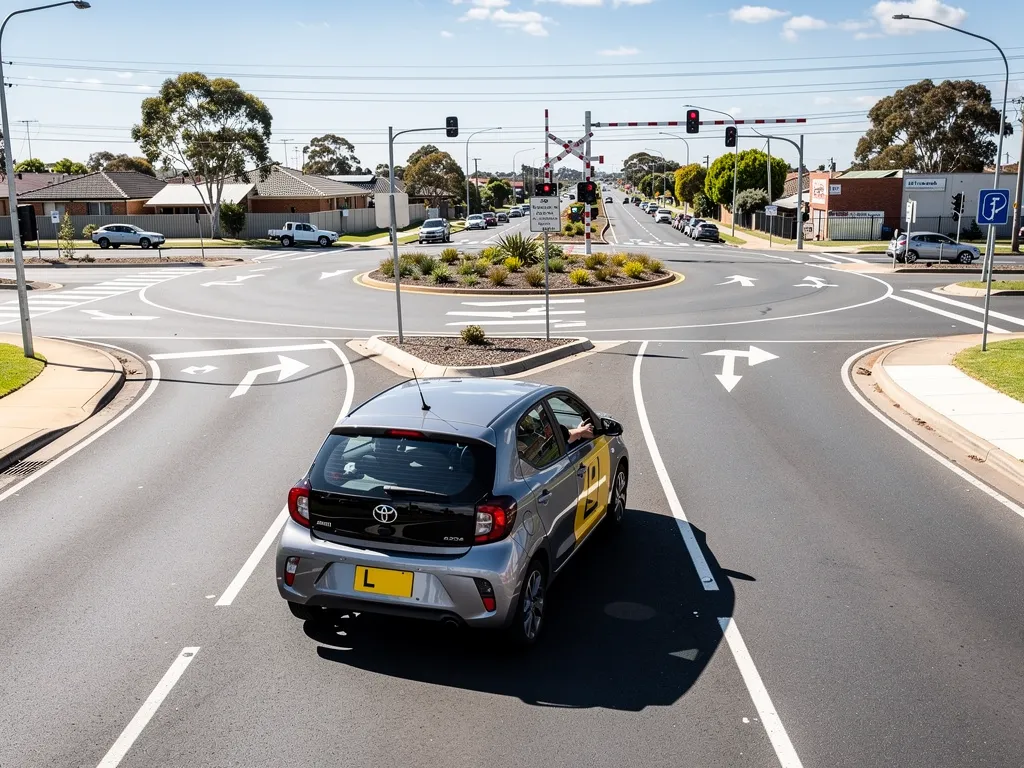
Navigating the Pakenham Rail Corridor & Level Crossing Protocols
One of the most critical components of the vicroads pakenham test routes involves safely navigating the heavily trafficked railway level crossings near Bald Hill Rd. Mastery of precise stopping distances and compliance with boom gate signals is essential to avoid immediate fail penalties.
- Stopping Distance Behind Yellow Box Markings: Candidates must stop the vehicle behind the solid white stop line and the adjacent yellow hatched box area, ensuring no part of the vehicle is within this zone to prevent obstruction of the rail crossing. The recommended minimum distance is at least 1.5 meters behind these markings.
- Boom Gate Descent Timing: When the boom gate lights activate or begin to lower, it’s imperative to stop promptly before the designated line. Proceeding beyond this point or attempting to cross before gates fully lift is a critical error.
- Avoiding Intersection Blocking Near Bald Hill Rd: Since crossings are close to intersection slip lanes and traffic signals, candidates must ensure the vehicle does not block any intersection points or pedestrian pathways when waiting, showing awareness of traffic flow and local signalling.
These protocols are reinforced throughout the pakenham driving test tips and practice routines with certified instructors offering driving lessons pakenham tailored to the unique hazards of the rail corridor.
Stage 1: Low-Speed Control and Vehicle Handling (Approx. 10 Minutes)
This initial stage focuses on demonstrating precision in low-speed environments within the residential and industrial pockets primarily along Southeast Blvd and Bald Hill Rd: driving school doveton
- Reverse Parallel Parking: Candidates must park within 30cm of the kerb and approximately 1-2 meters behind the target vehicle, exhibiting control and spatial awareness.
- Three-Point Turns: When roads are narrow, a precise five-point turn may be executed instead, testing ability to maneuver in confined spaces.
- Kerbside Stop and Start: Ensures competence in managing the vehicle smoothly at the curb, including appropriate signaling, observation, and control.
Stage 2: High-Speed Arterial Roads and Freeway Driving (Approx. 20 Minutes)
This stage transitions candidates to faster traffic conditions, addressing skills critical for real-world driving on Pakenham’s arterial road network:
- Cardinia Road and Princes Highway (C101): Assessment includes safely navigating these busier and higher-speed routes, maintaining lane discipline and awareness.
- Racecourse Precinct: Handling of merging and lane changes within this evolving precinct is examined.
- Princes Freeway (M1) Merge: Candidates demonstrate the ability to perform safe and timely merges onto the freeway at speeds up to 100 km/h, including vigilant head checks and speed matching with traffic.
Complex Local Driving Hazards & Test Challenges in Pakenham
Pakenham’s driving test routes are characterized by several complex hazards. Understanding and preparing for these is essential for success. The following pakenham driving test tips address these challenges explicitly.
Pakenham Railway Level Crossings
- Frequent train activity requires learners to approach with heightened caution and readiness to stop.
- Comply fully with stop lines and observe yellow-hatched box rules, ensuring no part of the vehicle remains over the tracks.
- Never proceed unless there is clear exit space beyond the crossing to prevent being trapped on the tracks.
Multi-Lane Roundabouts (Cardinia Rd & Southeast Blvd)
- Correct lane selection is key: use the left lane for left or straight movements, and the right lane for right turns or U-turns.
- Signal left on exit to clearly communicate intentions to other road users.
- Maintain consistent observation for other vehicles, cyclists, and pedestrians during approach, navigation, and exit.
Rapid Speed Transitions & School Zones
- Pakenham features strictly enforced 40 km/h school zones active during specific times.
- Drivers must adapt smoothly when transitioning between 50 km/h residential streets, 60/70/80 km/h arterial roads, and the 100 km/h freeway speed zones.
- Anticipate these changes ahead to avoid abrupt speed adjustments that could be flagged during assessment.
Heavy Vehicle Interactions
- The test routes often intersect industrial corridors shared with B-doubles and large trucks, particularly around Southeast Blvd.
- Maintain safe following distances and demonstrate patience and awareness when sharing the road with heavy vehicles.
VicRoads Scoring Criteria: Understanding Errors and Test Fails
Understanding how the test is scored and what constitutes critical or immediate fail errors can help learners focus their preparation strategically.
Critical Errors:
- Failure to conduct blind spot head checks before turning, merging, changing lanes, or pulling away from the kerb.
- Unsafe gap judgment in high-speed traffic, especially on Princes Highway.
- Not yielding right-of-way correctly at intersections and roundabouts.
- Inconsistent signaling or failure to signal as required.
Immediate Fail Errors:
- Exceeding speed limits at any stage.
- Disobeying traffic signals or stop signs.
- Dangerous maneuvers requiring instructor or testing officer intervention.
- Causing an accident or near-miss during the test.
Head-Check Discipline:
Performing a full and deliberate head check of blind spots before every maneuver is crucial and rigorously assessed. This includes:
- Before merging onto Cardinia Road or the M1 freeway.
- Before every lane change or turn.
- When pulling away from the kerb or stop line.
Comprehensive Test-Day Checklist & Pre-Drive Check Routine
Ensuring all documentation and vehicle conditions are in order helps avoid unnecessary stress on test day.
- Logbook Verification: Confirm your learner logbook has at least 120 logged hours, including 20 night hours for drivers under 21.
- Hazard Perception Test: Must be successfully completed and all requirements met prior to booking the driving test.
- Vehicle Roadworthiness Checks: Test your vehicle in advance for:
- Documentation: Carry your learner permit, logbook, booking confirmation, and a form of photo ID.
Local Preparation Advantage with Your Local Driving Academy
Opting for professional driving lessons pakenham with certified instructors brings distinct benefits:
- Expertise: ADTA/DIA certified professionals familiar with VicRoads Pakenham test routes impart tailored guidance and best practice techniques.
- Mock Test Simulations: Realistic test environment rehearsals allow learners to experience the official routes, hazards, and timing, reducing anxiety and improving performance.
- Skill Refinement: Targeted feedback and drill training focus on areas like parallel parking, freeway merging, and navigating complex roundabouts.
- Flexible Packages: Designed to suit varying learner levels and schedules, including intensive crash courses and extended coaching.
Frequently Asked Questions: Passing the VicRoads Driving Test at Pakenham
Q: Where is the VicRoads Pakenham test conducted?
A: Tests are conducted at the VicRoads Pakenham Customer Service Centre, located at Southeast Blvd, Pakenham VIC 3810.
Q: How are the test routes structured?
A: The test is divided into two stages—Stage 1 with low-speed maneuvers in residential and commercial areas, and Stage 2 covering higher-speed arterial roads and freeway merging.
Q: What common mistakes should I avoid?
A: Avoid neglecting blind spot checks, misjudging traffic gaps, and failing to yield right-of-way at intersections and roundabouts.
Q: How can I best prepare for the unique local hazards found in Pakenham?
A: Practice maneuvering around railway crossings, multi-lane roundabouts, and speed transitions, ideally under the guidance of certified instructors familiar with Pakenham’s routes.
Q: What services does Your Local Driving Academy provide for test preparation?
A: We offer customized lessons including mock tests with experienced instructors trained specifically in the VicRoads Pakenham route dynamics.
Q: What is the pass rate at VicRoads Pakenham?
A: While pass rates fluctuate, thorough preparation and familiarity with local test routes generally boost success rates well above the state average.
Q: How does the M1 freeway merge work during the Pakenham test?
A: Candidates must safely accelerate to freeway speeds, conduct clear head checks to confirm gap availability, and merge smoothly without disrupting existing traffic flow.
Q: What happens if a train approaches at the level crossing during my test?
A: You must stop safely behind the stop line and wait for the train to pass before proceeding. The instructor will observe your compliance with these critical safety rules.
Q: Can I choose between reverse parallel parking and 3-point turn?
A: The examiner may request either maneuver depending on test circumstances; being proficient in both is recommended.
Q: How do I book driving lessons and test packages in Pakenham?
A: Contact Your Local Driving Academy via our website or phone to arrange tailored lesson plans and test packages designed around your individual needs and timeline.
This guide is designed to provide learner drivers with an authoritative and encouraging framework to approach their VicRoads Pakenham driving test with confidence and competence. With comprehensive preparation and skilled support, passing the driving test on vicroads pakenham test routes is an achievable and rewarding milestone.