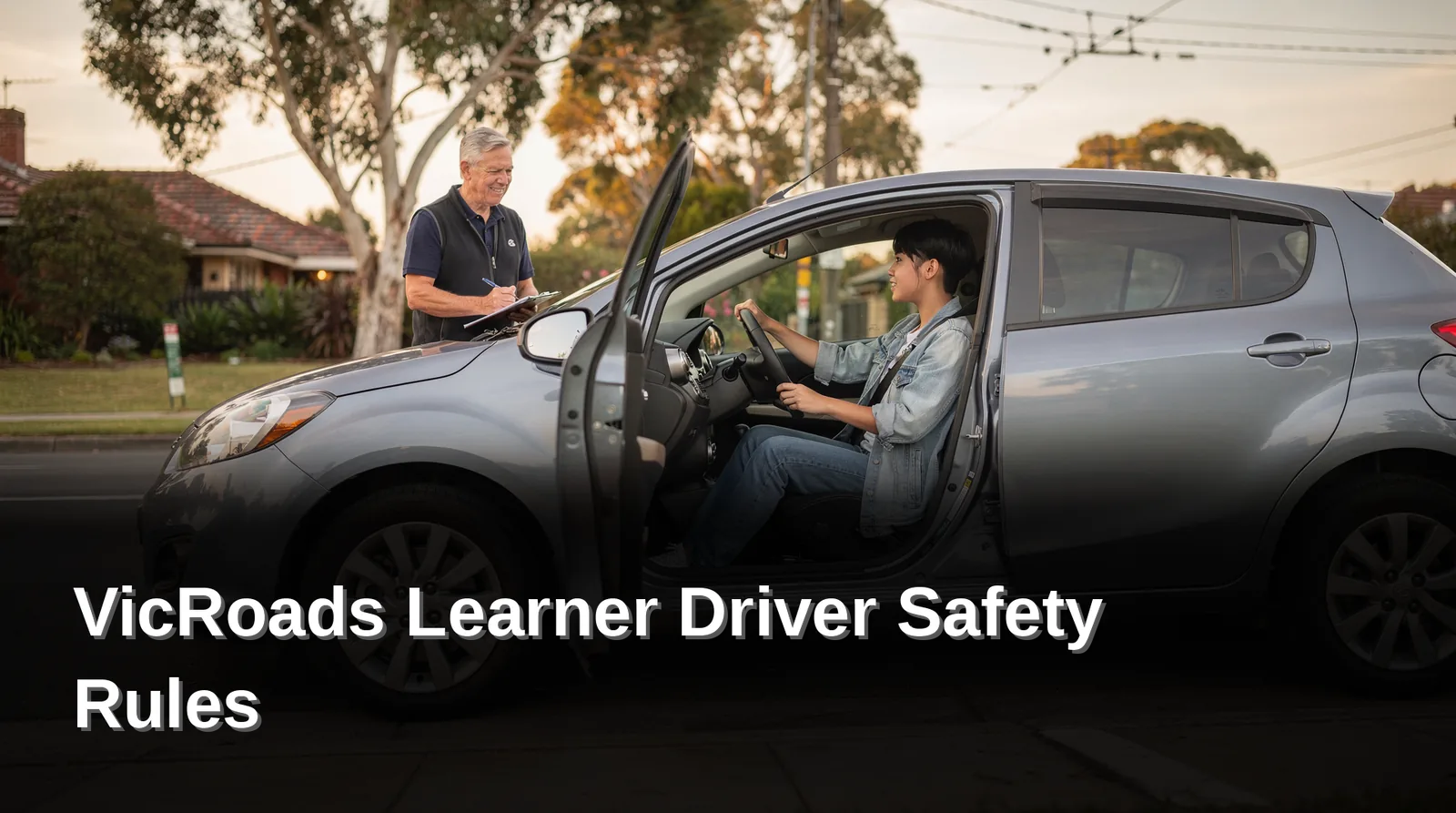
Melbourne learner drivers must meet specific VicRoads requirements before attempting the practical drive test. Candidates must be at least 18 years old, hold a current learner permit for the minimum period, and complete 120 supervised driving hours (including 20 night hours) if under 21. Your Local Driving Academy achieves strong first-time pass outcomes among its Melbourne students.
Key Takeaways
- Learners under 21 must complete 120 supervised hours including 20 night hours before testing.
- VicRoads requires a current learner permit, identity documents, and proof of Victorian residential address.
- A vehicle failing any inspection point (horn, lights, wipers, demisters, or seatbelts) disqualifies the test immediately.
- VicRoads cross-references its database for active license sanctions or unresolved Fines Victoria obligations.
What prerequisites must Melbourne learners meet?
Melbourne learner drivers must satisfy specific VicRoads eligibility criteria before booking a practical drive test. The VicRoads Learner Driver Safety Rules framework establishes these prerequisites to ensure every applicant demonstrates adequate supervised experience and personal readiness. Failing to meet any single requirement results in immediate test disqualification, wasting the application fee and delaying license progression by weeks or months.
What is the minimum age for a probationary license test?
Applicants must be at least 18 years old to apply for a probationary driver license. VicRoads enforces this age threshold without exception. Learners who attempt to book a test before their 18th birthday find their application rejected at the counter or online portal.
How many supervised driving hours does VicRoads require?
Drivers under 21 years of age must log a minimum of 120 hours of supervised driving. This total includes 20 hours of night driving, a requirement designed to build competence in low-visibility conditions. The logbook serves as the official record, and VicRoads officers verify its completeness before allowing a test booking. Incomplete or unverified hours block the application entirely.
Additional prerequisites include holding a current car learner permit for the minimum statutory period. VicRoads also requires a Victorian residential address and the necessary identity documents. Applicants without these documents cannot proceed, regardless of their driving skill level. The VicRoads Learner Permit Requirements outline the full documentation checklist Melbourne learners need before visiting a VicRoads center.
What happens if a learner’s permit has been suspended?
A suspended, canceled, or disqualified permit status renders the applicant ineligible. VicRoads cross-references its database for any active license sanctions or outstanding relicensing obligations. Learners with unresolved Fines Victoria sanctions face automatic rejection. Clearing all administrative holds before applying prevents costly delays and protects the test booking window.
Which documents are required on test day?
Learners must present a current learner permit card and the necessary identity documents at the VicRoads test appointment. Missing paperwork halts the assessment before the vehicle moves. VicRoads eligibility rules confirm that applicants must have the required identity documents and a Victorian residential address.
VicRoads Learner Driver Safety Rules govern every stage of the licensing process, including document verification. A learner who arrives without the correct paperwork forfeits the booking fee and loses the test slot.
What identification must a learner bring?
The following items are mandatory on test day:
- A current Victorian learner permit card
- The necessary identity documents specified by VicRoads
- Proof of a Victorian residential address
What about logbook hours and payment?
Learners under 21 must provide a signed logbook declaration or approved myLearners app verification showing 120 supervised hours, including 20 night hours. Payment confirmation and appointment booking details must also be presented. VicRoads requires applicants to pay the appropriate fees before the test proceeds.
Are there any outstanding obligations that block testing?
A learner must not have a Fines Victoria license sanction or any outstanding relicensing requirements. These obligations block the test regardless of driving skill. First-time learners preparing for the Melbourne drive test should review the full Melbourne driving test preparation guide before booking.
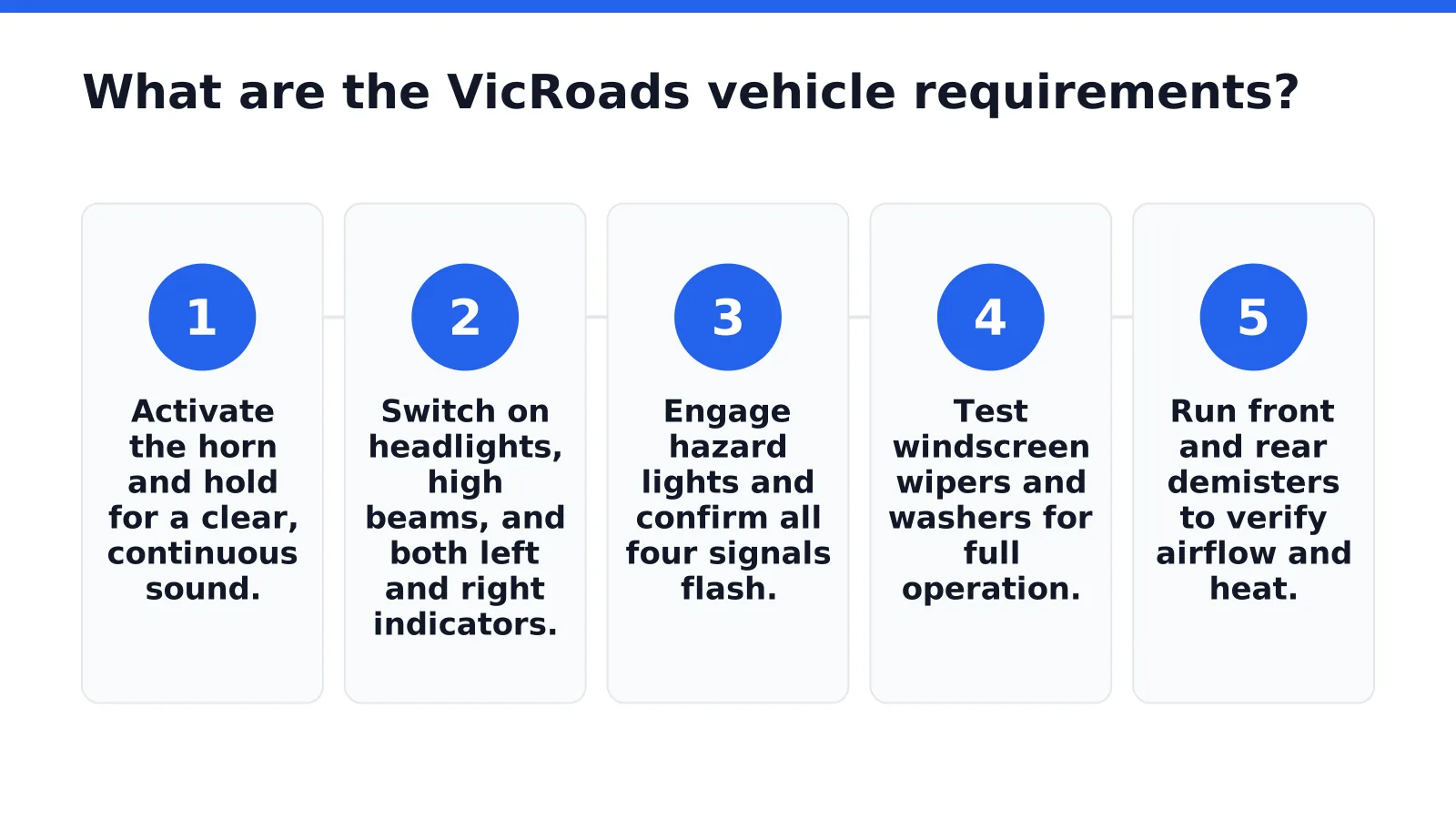
What are the VicRoads vehicle requirements?
VicRoads enforces strict vehicle standards before any on-road assessment begins. A vehicle failing these checks results in immediate test disqualification, wasting the applicant’s time and the booking fee. Victoria’s driving test pass rate sits at approximately 75%, and a notable portion of the remaining 25% are disqualified because the car does not meet the rules before the driving assessment even starts, according to the Master VicRoads Driving Test Car Requirements 2026 guide. This preventable outcome costs learners weeks of waiting for a new test slot.
What pre-drive safety checks does the testing officer perform?
The testing officer conducts a systematic inspection before entering the vehicle. Every function must operate correctly on demand.
- Activate the horn and hold for a clear, continuous sound.
- Switch on headlights, high beams, and both left and right indicators.
- Engage hazard lights and confirm all four signals flash.
- Test windscreen wipers and washers for full operation.
- Run front and rear demisters to verify airflow and heat.
A single malfunction in any of these components halts the test immediately. The vehicle must be clean, roadworthy, and display no warning lights on the dashboard. Tyre tread depth must meet the legal minimum, and all seatbelts must retract and lock properly. Treating the car check as part of the test, not as an afterthought, prevents last-minute surprises.
Can a learner use their own car for the VicRoads test?
A privately owned vehicle is permitted if it passes every inspection point. However, dual-control vehicles are recommended for the practical assessment. Many Melbourne learners use an instructor’s car to avoid disqualification over minor compliance issues. Your Local Driving Academy provides modern, dual-control vehicles that satisfy all VicRoads safety procedures before the driving test, eliminating uncertainty about equipment failures. This approach removes the most common administrative reason for test rejection before the engine starts.
How is the two-stage drive test structured?
The VicRoads drive test follows a two-stage structure totaling approximately 30 minutes. Stage 1 assesses basic car control, while Stage 2 evaluates performance in higher-speed and complex traffic conditions.
A pre-drive safety check precedes the on-road assessment. The testing officer verifies the horn, wipers, hazard lights, and demisters before the vehicle moves. Learners who overlook this requirement risk disqualification before driving begins. Victoria’s driving test pass rate sits at about 75%, and a notable portion of the remaining 25% fail because the vehicle does not meet the rules before the on-road assessment starts, as noted in the Master VicRoads Driving Test Car Requirements 2026 guide.
What happens in Stage 1 of the drive test?
Stage 1 lasts approximately 10 minutes. The assessment covers basic car control, parking, and low-speed maneuvers. Learners demonstrate precise vehicle handling in controlled, low-risk environments.
What happens in Stage 2 of the drive test?
Stage 2 runs approximately 20 minutes. The testing officer directs the learner through higher-speed zones, busy traffic, and complex Melbourne intersections. This stage demands sustained hazard awareness and confident decision-making under real traffic pressure.
Learners preparing for the test should review the full VicRoads driving test requirements before booking. Your Local Driving Academy structures lessons to mirror both stages, ensuring clients build competence in low-speed control before progressing to high-traffic scenarios.
What common mistakes cause automatic failure?
Immediate termination errors and critical speed management failures produce automatic fail outcomes on the Melbourne drive test. Poor scanning, inadequate mirror checks, and loss of vehicle control account for a substantial portion of unsuccessful assessments.
Three categories of mistakes trigger automatic failure.
Immediate termination errors end the test instantly. The testing officer intervenes when a learner creates an unsafe situation. Collisions, mounting a kerb at speed, and disobeying traffic signals fall into this category. The test stops immediately.
Critical speed management mistakes accumulate across the assessment. Driving 10 km/h or more below the posted limit without reason counts as one critical error. Exceeding the speed limit by any margin constitutes another. Each critical error moves a learner closer to automatic failure.
Observation failures reflect poor scanning technique. Mirrors require checking every 5 to 10 seconds. Blind spots demand a deliberate head check before every lane change or merge. Missing these checks repeatedly builds critical errors fast.
What Melbourne-specific road features cause critical errors?
Navigating Melbourne roundabouts, hook turns, and school zones demands precise control and timing. Roundabouts require correct indication on entry and exit plus continuous scanning for cyclists. Hook turns confuse inexperienced drivers unfamiliar with the CBD manoeuvre. School zones carry reduced limits during posted hours. Missing a sign activation time creates an instant speed infraction.
How do VicRoads safety rules affect test outcomes?
The VicRoads Learner Driver Safety Rules emphasize consistent hazard awareness and defensive driving techniques. Testing officers assess whether a learner identifies hazards early and responds with smooth, safe decisions. Failing to slow for a pedestrian at a crossing or not giving way at an intersection demonstrates poor hazard response. These errors, detailed in the 10 common driving test mistakes guide, reflect gaps in defensive driving judgment that the rules require. Without consistent observation and speed control, a learner cannot demonstrate the safety standard the test demands.
FAQ
How many supervised driving hours do I need for the VicRoads test?
Drivers under 21 must log 120 supervised hours including 20 night hours. Incomplete or unverified hours block the test booking entirely.
What documents must I bring to the VicRoads test appointment?
You need a current learner permit card, identity documents, and proof of a Victorian residential address. Missing paperwork stops the assessment immediately.
What happens if my learner permit is suspended before the test?
A suspended, canceled, or disqualified permit makes you ineligible until all sanctions are cleared. Meeting the VicRoads driving test requirements demands disciplined preparation across vehicle compliance, structured skill development, and consistent hazard awareness. Learners who master the two-stage format, eliminate critical errors, and understand Melbourne-specific road rules position themselves for success. The documented pass rate confirms that thorough preparation translates directly into assessment outcomes. Every learner should review the complete requirements, verify their logbook hours, and practice under conditions that mirror the actual test environment before booking their appointment.